
HookMesh vs qtrl.ai
Side-by-side comparison to help you choose the right AI tool.

HookMesh
Streamline your SaaS with reliable webhook delivery, automatic retries, and a self-service customer portal.

qtrl.ai
qtrl.ai helps QA teams scale testing with AI agents while keeping full control and governance.
Last updated: February 27, 2026
Visual Comparison
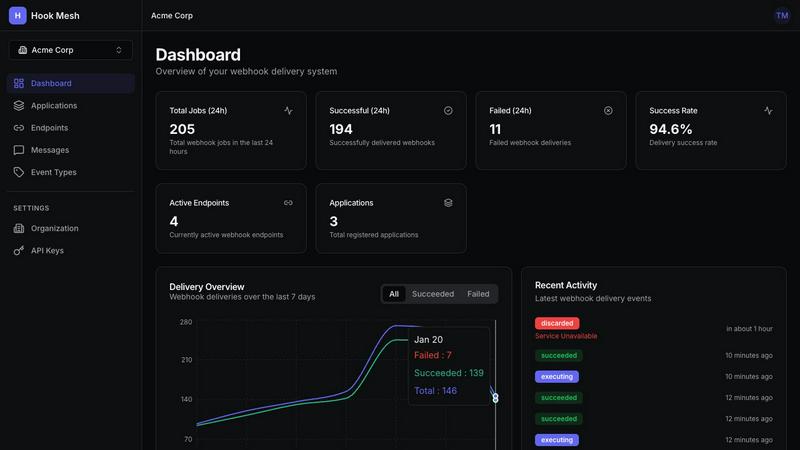
HookMesh
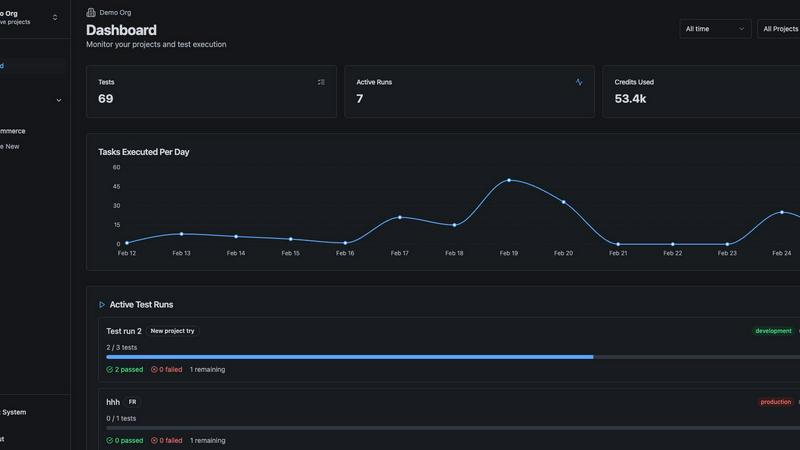
qtrl.ai
Feature Comparison
HookMesh
Reliable Delivery
HookMesh guarantees that your webhook events are never lost. With automatic retries implemented using exponential backoff and jitter, the platform retries failed deliveries for up to 48 hours. This ensures that even if the endpoint is temporarily down, your webhook will eventually be delivered without manual intervention.
Customer Portal
The self-service customer portal empowers users to manage their webhooks effortlessly. It features an embeddable UI that allows customers to add endpoints, view detailed delivery logs, and gain full visibility of request/response data. This transparency helps in quickly identifying and resolving issues.
At-Least-Once Delivery
To ensure that no webhook is missed, HookMesh employs an at-least-once delivery mechanism alongside idempotency keys. This guarantees that each event is delivered at least once, preventing data loss while allowing clients to handle duplicate events gracefully.
Developer Experience
HookMesh is designed with developers in mind, offering a REST API and official SDKs in JavaScript, Python, and Go. This allows developers to integrate webhook functionality into their applications with just a few lines of code, significantly speeding up the onboarding process and reducing development time.
qtrl.ai
Enterprise-Grade Test Management
qtrl provides a robust, centralized system for all your testing artifacts. You can create and organize test cases, build detailed test plans, and execute structured test runs. Everything is linked for full traceability, allowing you to see exactly which requirements are covered by which tests. This creates clear audit trails and is built to support compliance needs, giving managers and stakeholders complete confidence in the testing process.
Autonomous QA Agents
This is the intelligent engine of qtrl. These AI-powered agents can execute high-level instructions on demand. You can describe a test scenario in natural language, like "test the checkout flow as a guest user," and the agent will run it in a real browser. They operate within your defined rules and can run continuously across different environments, providing scalable automation that adapts to your application's changes without constant manual script updates.
Progressive Automation Model
qtrl doesn't force you to jump into full AI automation. You start where you are comfortable, writing clear test instructions for the agents to follow. As trust builds, you can let qtrl suggest and generate new tests automatically based on coverage gaps or requirement changes. Every step is reviewable and approvable, ensuring your team always stays in the driver's seat while gradually increasing efficiency.
Governance by Design
Trust and control are foundational to qtrl. The platform offers permissioned autonomy levels, so you decide how much freedom the AI agents have. There are no black-box decisions; you get full visibility into what the agents are doing. Combined with enterprise-ready security, encrypted secrets management, and the fact that secrets are never exposed to the AI, qtrl provides the governance framework necessary for serious engineering teams to adopt AI confidently.
Use Cases
HookMesh
E-commerce Order Processing
In the e-commerce sector, businesses can use HookMesh to handle order-related webhooks seamlessly. For instance, when an order is completed, HookMesh ensures that the notification is reliably sent to inventory management systems, customer relationship management platforms, or other relevant services without any hiccups.
SaaS Product Updates
SaaS companies can leverage HookMesh to notify users about updates or changes in their services. For example, when a new feature is released, HookMesh can send webhook notifications to user accounts, ensuring that all clients are informed in real-time about important updates.
Payment Processing Notifications
Payment gateways can utilize HookMesh to send instant notifications upon successful transactions. By ensuring that these critical notifications are reliably delivered, businesses can maintain accurate transaction records and improve customer satisfaction.
API Integration for Third-Party Services
HookMesh is perfect for businesses that need to integrate with third-party services via webhooks. For example, a marketing automation tool can send data about new leads to a CRM system, ensuring that all data flows seamlessly and reliably between platforms.
qtrl.ai
Scaling Beyond Manual Testing
For QA teams overwhelmed by repetitive manual test cycles, qtrl offers a clear path forward. They can begin by documenting their existing manual tests as structured instructions in qtrl's management module. From there, they can progressively automate the most tedious flows using the AI agents, freeing up human testers for more complex exploratory work and dramatically increasing test coverage and execution speed.
Modernizing Legacy QA Workflows
Companies stuck with outdated, script-heavy automation frameworks can use qtrl to transition smoothly. Instead of maintaining brittle scripts, teams can leverage qtrl's adaptive memory and AI agents to generate more resilient tests. The platform integrates with existing CI/CD pipelines and tools, allowing for a gradual modernization without a disruptive, all-at-once overhaul of the current process.
Ensuring Governance in Enterprise QA
Large organizations with strict compliance and audit requirements need control alongside automation. qtrl's full traceability from requirement to test execution, combined with its permissioned autonomy and detailed audit logs, makes it ideal. Engineering leads can scale QA efforts with AI while providing auditors with clear evidence of what was tested, when, and what the outcome was.
Empowering Product-Led Engineering Teams
Development teams that practice continuous deployment need fast, reliable feedback on quality. qtrl integrates into their workflow, allowing developers to write high-level test instructions for features they build. The autonomous agents can then execute these tests across environments as part of the CI/CD process, providing continuous quality feedback without requiring developers to become experts in test automation frameworks.
Overview
About HookMesh
HookMesh is an innovative solution designed to simplify and enhance webhook delivery for modern SaaS products. It addresses the complexities that come with building webhooks in-house, such as retry logic, circuit breakers, and debugging delivery issues. With HookMesh, businesses can focus on their core products instead of getting bogged down by the technical challenges of webhook management. This robust platform offers battle-tested infrastructure, ensuring reliable delivery through automatic retries, exponential backoff, and idempotency keys. HookMesh is ideal for developers and product teams looking to provide a seamless experience for their customers while ensuring that webhook events are delivered consistently and reliably. With a self-service portal for customers, HookMesh not only facilitates easy endpoint management and visibility but also allows users to replay failed webhooks with one click, making it the go-to choice for organizations seeking peace of mind in their webhook strategy.
About qtrl.ai
qtrl.ai is a modern QA platform designed to help software teams scale their quality assurance efforts without sacrificing control or governance. It uniquely combines enterprise-grade test management with powerful, trustworthy AI automation. At its core, qtrl provides a centralized hub where teams can organize test cases, plan test runs, trace requirements to coverage, and track quality metrics through real-time dashboards. This structured foundation ensures clear visibility into what's been tested, what's passing, and where potential risks lie for engineering leads and QA managers.
Where qtrl truly stands apart is its progressive AI layer. Instead of forcing a risky, "black-box" AI-first approach, qtrl introduces intelligent automation gradually. Teams can start with simple manual test management and, when ready, leverage built-in autonomous agents. These agents can generate UI tests from plain English descriptions, maintain them as the application evolves, and execute them at scale across multiple browsers and environments. This makes qtrl perfect for product-led engineering teams, QA groups moving beyond manual testing, companies modernizing legacy workflows, and enterprises that require strict compliance and audit trails. Ultimately, qtrl's mission is to bridge the gap between the slow pace of manual testing and the brittle complexity of traditional automation, offering a trusted path to faster, more intelligent quality assurance.
Frequently Asked Questions
HookMesh FAQ
What is HookMesh?
HookMesh is a webhook delivery service that simplifies the process of delivering webhooks by managing retry logic, circuit breakers, and visibility for developers and their customers.
How does HookMesh ensure reliable webhook delivery?
HookMesh uses automatic retries with exponential backoff and jitter, along with circuit breakers to disable failing endpoints temporarily, ensuring that your webhooks are delivered reliably.
Can customers manage their own endpoints?
Yes, HookMesh provides a self-service portal where customers can manage their endpoints, view delivery logs, and replay failed webhooks with just one click, enhancing user experience.
What programming languages are supported by HookMesh?
HookMesh offers official SDKs for JavaScript, Python, and Go, making it easy for developers to integrate webhook functionality into their applications with minimal effort.
qtrl.ai FAQ
How does qtrl's AI handle changes in my application's UI?
qtrl's autonomous agents are designed with adaptive memory. They build a living knowledge base of your application by learning from every exploration and test execution. When the UI changes, this context helps the AI understand the new structure. It can often adjust test steps automatically, and when it can't, it will flag the test for human review, making maintenance far less brittle than traditional coded automation.
Is my test data and application access secure with an AI agent?
Absolutely. Security and governance are core to qtrl's design. The platform uses enterprise-grade security practices. Crucially, any sensitive data like passwords or API keys are stored as encrypted environment secrets. These secrets are never exposed to the AI agent during execution; the system injects them securely, ensuring your credentials and data remain protected at all times.
Can I use qtrl if I only want test management without AI?
Yes, definitely. qtrl is built on a progressive automation model. You can use it solely as a powerful, structured test management platform from day one. The AI features are there to augment your workflow when you're ready. You can introduce AI-assisted test generation and execution at your own pace, starting with simple instruction-based execution and increasing autonomy over time.
How does qtrl integrate with our existing development tools?
qtrl is built to fit into real-world engineering workflows. It offers integrations for requirements management tools and full support for CI/CD pipelines. This means you can trigger test runs automatically from a pull request or a build, and feed results back into your monitoring dashboards. It's designed to work alongside your current toolchain, not replace it entirely.