
Open Claw Directory vs qtrl.ai
Side-by-side comparison to help you choose the right AI tool.

Open Claw Directory
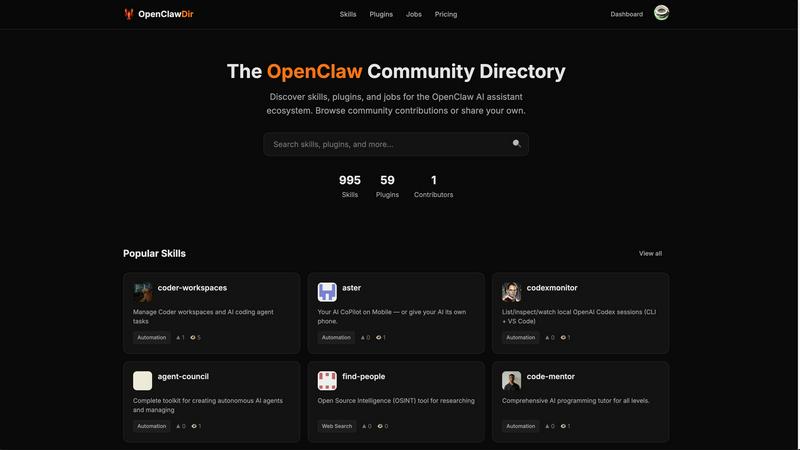
Explore skills, plugins, and job opportunities within the OpenClaw AI assistant ecosystem to enhance your experience.
Last updated: February 26, 2026

qtrl.ai
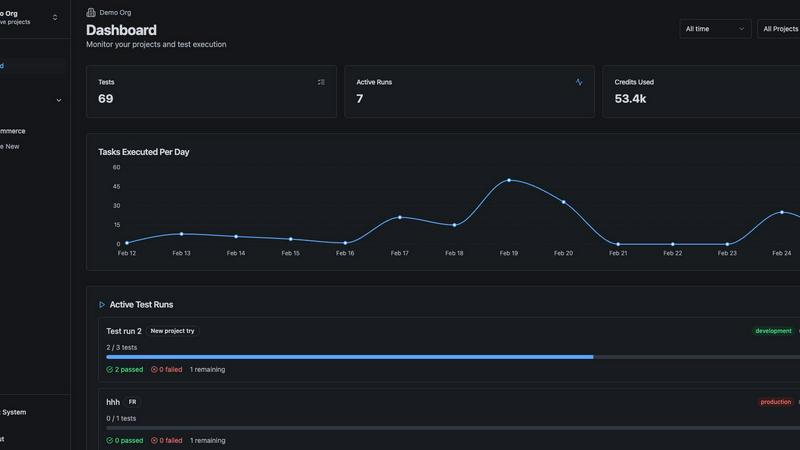
qtrl.ai helps QA teams scale testing with AI agents while keeping full control and governance.
Last updated: February 27, 2026
Visual Comparison
Open Claw Directory
qtrl.ai
Feature Comparison
Open Claw Directory
Extensive Resource Listings
OpenClaw Directory boasts an extensive collection of over 3,000 skills and 500 plugins, providing users with a wide range of options to enhance their AI assistant's capabilities. This vast catalog encourages exploration and creativity, allowing users to find the perfect tools for their specific needs.
Community Contributions
The platform fosters a collaborative environment where developers can submit their own skills, plugins, and job listings. This feature not only enriches the directory but also empowers users to share their innovations and help others in the community, creating a vibrant ecosystem of shared knowledge.
Categorized Browsing
Users can easily navigate through various categories of skills and plugins, such as Automation, Productivity, and Communication. This organized structure enables users to quickly locate the tools they need, streamlining the process of enhancing their AI assistant and improving overall efficiency.
Job Listings
OpenClaw Directory includes a section dedicated to job listings, connecting developers and users with potential employment opportunities within the OpenClaw ecosystem. This feature is particularly beneficial for those looking to further their careers in AI and technology, providing a platform for networking and professional growth.
qtrl.ai
Enterprise-Grade Test Management
qtrl provides a robust, centralized system for all your testing artifacts. You can create and organize test cases, build detailed test plans, and execute structured test runs. Everything is linked for full traceability, allowing you to see exactly which requirements are covered by which tests. This creates clear audit trails and is built to support compliance needs, giving managers and stakeholders complete confidence in the testing process.
Autonomous QA Agents
This is the intelligent engine of qtrl. These AI-powered agents can execute high-level instructions on demand. You can describe a test scenario in natural language, like "test the checkout flow as a guest user," and the agent will run it in a real browser. They operate within your defined rules and can run continuously across different environments, providing scalable automation that adapts to your application's changes without constant manual script updates.
Progressive Automation Model
qtrl doesn't force you to jump into full AI automation. You start where you are comfortable, writing clear test instructions for the agents to follow. As trust builds, you can let qtrl suggest and generate new tests automatically based on coverage gaps or requirement changes. Every step is reviewable and approvable, ensuring your team always stays in the driver's seat while gradually increasing efficiency.
Governance by Design
Trust and control are foundational to qtrl. The platform offers permissioned autonomy levels, so you decide how much freedom the AI agents have. There are no black-box decisions; you get full visibility into what the agents are doing. Combined with enterprise-ready security, encrypted secrets management, and the fact that secrets are never exposed to the AI, qtrl provides the governance framework necessary for serious engineering teams to adopt AI confidently.
Use Cases
Open Claw Directory
Enhancing AI Capabilities
Users can browse the extensive list of skills and plugins to find the perfect enhancements for their OpenClaw AI assistant. For example, marketers can discover AI advertising agents that automate ad campaigns, while developers can find tools for managing coding tasks, making their workflows more efficient.
Community Engagement
Developers can actively contribute to the directory by submitting new skills and plugins, fostering a sense of community. This engagement not only helps in sharing knowledge but also allows contributors to gain recognition for their work, creating a collaborative atmosphere that benefits everyone involved.
Career Development
Job seekers can utilize the job listings section to explore career opportunities specifically related to the OpenClaw ecosystem. This feature enables users to connect with like-minded professionals and find positions that match their skills and interests in the growing field of AI technology.
Custom Solutions
Businesses can leverage the directory to find tailored solutions for their specific needs. By exploring various categories, companies can identify and implement the right plugins and skills that align with their operational requirements, ultimately enhancing productivity and efficiency.
qtrl.ai
Scaling Beyond Manual Testing
For QA teams overwhelmed by repetitive manual test cycles, qtrl offers a clear path forward. They can begin by documenting their existing manual tests as structured instructions in qtrl's management module. From there, they can progressively automate the most tedious flows using the AI agents, freeing up human testers for more complex exploratory work and dramatically increasing test coverage and execution speed.
Modernizing Legacy QA Workflows
Companies stuck with outdated, script-heavy automation frameworks can use qtrl to transition smoothly. Instead of maintaining brittle scripts, teams can leverage qtrl's adaptive memory and AI agents to generate more resilient tests. The platform integrates with existing CI/CD pipelines and tools, allowing for a gradual modernization without a disruptive, all-at-once overhaul of the current process.
Ensuring Governance in Enterprise QA
Large organizations with strict compliance and audit requirements need control alongside automation. qtrl's full traceability from requirement to test execution, combined with its permissioned autonomy and detailed audit logs, makes it ideal. Engineering leads can scale QA efforts with AI while providing auditors with clear evidence of what was tested, when, and what the outcome was.
Empowering Product-Led Engineering Teams
Development teams that practice continuous deployment need fast, reliable feedback on quality. qtrl integrates into their workflow, allowing developers to write high-level test instructions for features they build. The autonomous agents can then execute these tests across environments as part of the CI/CD process, providing continuous quality feedback without requiring developers to become experts in test automation frameworks.
Overview
About Open Claw Directory
OpenClaw Directory is a vibrant, community-driven platform designed to support the OpenClaw AI assistant ecosystem. This online resource serves as a comprehensive hub where users can discover, browse, and contribute a variety of skills, plugins, and relevant job listings that enhance the functionality of OpenClaw, an open-source AI agent that can be deployed locally and utilized through popular messaging platforms. The directory is particularly valuable for developers and users alike, offering insights into popular extensions, new contributions, and categories of skills that cater to diverse needs. With an active community of contributors, OpenClaw Directory empowers individuals to share their innovations, find new tools, and connect with job opportunities, making it an essential resource for anyone looking to maximize their experience with the OpenClaw ecosystem.
About qtrl.ai
qtrl.ai is a modern QA platform designed to help software teams scale their quality assurance efforts without sacrificing control or governance. It uniquely combines enterprise-grade test management with powerful, trustworthy AI automation. At its core, qtrl provides a centralized hub where teams can organize test cases, plan test runs, trace requirements to coverage, and track quality metrics through real-time dashboards. This structured foundation ensures clear visibility into what's been tested, what's passing, and where potential risks lie for engineering leads and QA managers.
Where qtrl truly stands apart is its progressive AI layer. Instead of forcing a risky, "black-box" AI-first approach, qtrl introduces intelligent automation gradually. Teams can start with simple manual test management and, when ready, leverage built-in autonomous agents. These agents can generate UI tests from plain English descriptions, maintain them as the application evolves, and execute them at scale across multiple browsers and environments. This makes qtrl perfect for product-led engineering teams, QA groups moving beyond manual testing, companies modernizing legacy workflows, and enterprises that require strict compliance and audit trails. Ultimately, qtrl's mission is to bridge the gap between the slow pace of manual testing and the brittle complexity of traditional automation, offering a trusted path to faster, more intelligent quality assurance.
Frequently Asked Questions
Open Claw Directory FAQ
What is OpenClaw?
OpenClaw is an open-source AI assistant that can be run locally and accessed through various messaging platforms. It is designed to help users automate tasks and improve communication through its extensive library of skills and plugins.
How can I contribute to OpenClaw Directory?
Users can contribute by submitting their own skills, plugins, or job listings to the directory. This collaborative approach helps expand the resource pool and fosters a community of innovation within the OpenClaw ecosystem.
Is OpenClaw Directory free to use?
Yes, OpenClaw Directory is a free resource for users to browse, discover, and contribute to the OpenClaw AI assistant ecosystem, promoting accessibility and community involvement.
How do I find specific skills or plugins?
Users can utilize the categorized browsing feature of OpenClaw Directory to easily navigate through different categories. This structured approach makes it simple to locate specific skills or plugins that meet your needs.
qtrl.ai FAQ
How does qtrl's AI handle changes in my application's UI?
qtrl's autonomous agents are designed with adaptive memory. They build a living knowledge base of your application by learning from every exploration and test execution. When the UI changes, this context helps the AI understand the new structure. It can often adjust test steps automatically, and when it can't, it will flag the test for human review, making maintenance far less brittle than traditional coded automation.
Is my test data and application access secure with an AI agent?
Absolutely. Security and governance are core to qtrl's design. The platform uses enterprise-grade security practices. Crucially, any sensitive data like passwords or API keys are stored as encrypted environment secrets. These secrets are never exposed to the AI agent during execution; the system injects them securely, ensuring your credentials and data remain protected at all times.
Can I use qtrl if I only want test management without AI?
Yes, definitely. qtrl is built on a progressive automation model. You can use it solely as a powerful, structured test management platform from day one. The AI features are there to augment your workflow when you're ready. You can introduce AI-assisted test generation and execution at your own pace, starting with simple instruction-based execution and increasing autonomy over time.
How does qtrl integrate with our existing development tools?
qtrl is built to fit into real-world engineering workflows. It offers integrations for requirements management tools and full support for CI/CD pipelines. This means you can trigger test runs automatically from a pull request or a build, and feed results back into your monitoring dashboards. It's designed to work alongside your current toolchain, not replace it entirely.
Alternatives
Open Claw Directory Alternatives
Open Claw Directory is a community-driven platform that serves as a resource hub for the OpenClaw AI assistant ecosystem. It enables users to explore a variety of skills, plugins, and job listings related to OpenClaw, an open-source AI agent designed for local deployment and interaction through messaging platforms. As an essential tool for developers and users alike, it organizes content into categories and promotes new contributions from the community. Users often seek alternatives to Open Claw Directory for several reasons, including pricing, specific feature sets, or compatibility with different platforms. When evaluating alternatives, consider factors such as the ease of use, the range of available resources, community engagement, and support for developers. A good alternative should not only fulfill your immediate needs but also provide opportunities for growth and collaboration within the AI assistant ecosystem.
qtrl.ai Alternatives
qtrl.ai is an AI-powered QA platform in the test management and automation category. It helps teams organize tests, execute runs, and gain visibility into quality through structured data and real-time dashboards. Its standout feature is an AI layer that can generate and maintain UI tests from natural language. Users often explore alternatives for various reasons. These can include budget constraints, the need for different feature sets, or specific integration requirements with their existing development stack. Some teams might prioritize pure open-source tools or seek a solution focused solely on manual test case management without an automation component. When evaluating other options, consider your team's primary needs. Key factors include the platform's scalability, its support for both manual and automated testing workflows, the ease of integrating with your CI/CD pipeline, and the depth of reporting and analytics offered. The ideal tool should align with your current QA maturity while supporting your growth toward more advanced practices.