

Causality Engine
Stop guessing which ads actually drive sales and start knowing with causal data that works without pixels or hype.
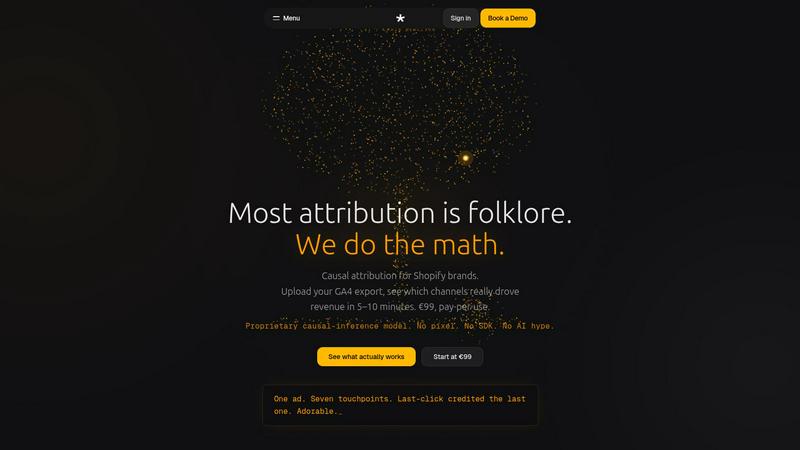
About Causality Engine
Causality Engine is a marketing attribution platform built specifically for e-commerce brands, designed to answer one critical question: which marketing channels actually drive sales? Unlike traditional analytics tools that rely on correlation and last-click models, Causality Engine uses proprietary causal inference to reveal the true impact of every channel in your marketing mix. The platform is built for brands doing at least €5,000 in monthly revenue who are tired of seeing their ad spend misattributed by tools like Google Analytics.
The problem with standard attribution is simple but costly. If a customer sees an Instagram ad, opens an email, then Googles your brand name and makes a purchase, Google gets 100 percent of the credit. The ad and the email get zero. This structural flaw causes marketers to systematically overspend on bottom-funnel channels and underfund the ones that actually create demand. Causality Engine fixes this by analyzing your Google Analytics CSV export and delivering a full causal attribution analysis in just five to ten minutes. No pixels, no SDKs, and no developer required.
The platform reveals 15 to 25 percent of revenue that traditional attribution simply cannot see, and it quantifies that revenue as an exact euro amount per channel. All data is hosted in the EU and the platform is GDPR-compliant from the ground up, with built-in right-to-erasure, data anonymisation, and fraud detection. Causality Engine is the math behind your marketing, giving you actionable answers instead of platform guesses.
Features of Causality Engine
Proprietary Causal Inference Model
Causality Engine uses a proprietary causal inference model that goes far beyond simple correlation. Instead of just tracking which clicks happened before a sale, the model identifies which channels actually caused the sale to occur. This means you get per-channel incremental ROAS with confidence intervals, so you know exactly how much revenue each channel is truly responsible for. The model is built specifically for e-commerce data and works with the messy, real-world data that comes out of Google Analytics 4.
No Pixel, No SDK, No Developer Needed
One of the biggest barriers to better attribution is technical setup. Causality Engine eliminates that entirely. You simply upload a Google Analytics CSV export and the platform does the rest. There are no pixels to install on your website, no SDKs to integrate into your app, and no developer time required. This makes advanced causal attribution accessible to any e-commerce brand, regardless of technical expertise. The entire process takes five to ten minutes from upload to answers.
EU-Hosted, GDPR-Compliant Data Infrastructure
All data processed by Causality Engine is hosted on EU servers, ensuring compliance with European data protection regulations. The platform is built with GDPR compliance as a foundation, not an afterthought. Features include full right-to-erasure, data anonymisation, and built-in fraud detection. This means you can trust that your customer data is handled securely and legally, without the risk of data being stored or processed in jurisdictions with weaker privacy protections.
Per-Channel Revenue Quantification
Instead of giving you vague percentages or abstract scores, Causality Engine delivers exact euro amounts per channel. The platform reveals the 15 to 25 percent of revenue that traditional attribution structurally cannot see, and it tells you exactly how much of that hidden revenue belongs to each channel. This granular, monetary quantification allows you to make precise budget allocation decisions. You can see that your email marketing is driving €2,000 more in incremental revenue than last-click suggested, or that your Meta ads are actually underperforming by €1,500.
Use Cases of Causality Engine
Recovering Hidden Revenue from Underfunded Channels
Many e-commerce brands are unknowingly starving their most effective channels. Last-click attribution systematically credits bottom-funnel channels like brand search while ignoring the demand-creation channels like social media and email. Causality Engine reveals this hidden lift, often showing that channels you were about to cut are actually driving significant incremental revenue. One brand, The Two Sisters, found that last-click said to cut Pinterest, but the causal read showed it was driving substantial revenue, so they kept it live and saw a 60 percent revenue lift.
Identifying and Cutting Ineffective Ad Spend
Just as importantly, Causality Engine can show you where your money is being wasted. A brand called Me Gorgeous used the platform to discover that €2,000 per month of their Meta ad spend was generating no incremental contribution. This allowed them to reallocate that budget to higher-performing channels, resulting in a 30 percent revenue lift in 2025. The causal model provides the confidence to make these cuts without fear of hurting sales, because you know exactly which spend is and isnt working.
Optimizing Multi-Channel Marketing Mix
For brands running campaigns across multiple platforms like Meta, Google, TikTok, Pinterest, email, and organic, the true contribution of each channel is nearly impossible to determine with standard tools. Causality Engine untangles this complexity by analyzing the full customer journey and attributing revenue based on causal impact, not last-click credit. This enables you to optimize your entire marketing mix, shifting budget from low-impact channels to high-impact ones, and creating a more efficient and effective overall strategy.
Validating Attribution Before Scaling Spend
Before committing to a larger budget on any channel, smart marketers want to know that the channel is actually driving sales. Causality Engine provides the validation you need to scale with confidence. By running a causal read on your existing data, you get a clear picture of which channels deserve more investment and which ones should be held steady or reduced. This is especially valuable for brands considering a major campaign launch or seasonal push, where getting the attribution right upfront can save thousands in wasted spend.
Frequently Asked Questions
What is marketing attribution and why should I care if mine is wrong?
Marketing attribution is the process of determining which marketing channels and touchpoints deserve credit for a sale. If your attribution is wrong, you are systematically making bad budget decisions. Last-click models, for example, give all credit to the last channel a customer clicked before buying. This causes you to overspend on bottom-funnel channels like brand search and underfund the channels that actually create demand, like social media and email. Over time, this leads to wasted ad spend, missed revenue opportunities, and a marketing strategy that is out of balance.
How is Causality Engine different from what Google and Meta already tell me?
Google Analytics and Meta Ads Manager both use attribution models that are built on correlation and last-click logic. They tell you what happened, not why it happened. Causality Engine uses causal inference to determine which channels actually caused the sale. This is a fundamentally different approach. For example, Google might tell you that brand search drove a sale, but the causal model might show that the Instagram ad from three days ago was the real cause. The result is that you get a true picture of channel performance, not a distorted one based on platform biases.
I am not technical. Can I actually use Causality Engine?
Yes, absolutely. Causality Engine is designed specifically for non-technical users. There are no pixels to install, no SDKs to integrate, and no developer needed. The entire process works by uploading a CSV export from Google Analytics 4. The platform handles all the complex causal inference math behind the scenes and presents the results in a clear, actionable dashboard. You do not need to understand statistics or coding to get value from the platform. The analysis takes five to ten minutes from upload to answers.
What is the pricing for Causality Engine and what do I get?
Causality Engine offers flexible pricing to match your needs. You can start with a single analysis for €99, which is perfect for a one-time audit of your marketing channels. For ongoing attribution, the Pro subscription is €299 per month and includes unlimited analyses, an AI chat feature for deeper insights, and full historical lookback so you can track performance over time. All plans come with a full refund if you do not see the value, so there is no risk in trying it on your data.
Pricing of Causality Engine
Causality Engine offers two primary pricing options. You can start with a single analysis for €99, which gives you a full causal attribution read of your Google Analytics data in five to ten minutes. For brands that need ongoing attribution, the Pro subscription is €299 per month and includes unlimited analyses, an AI chat for asking questions about your data, and full historical lookback so you can track channel performance over time. Both options come with a full refund guarantee if you do not see the value, making it risk-free to test the platform on your own data.
Similar to Causality Engine


Engineering on Web
Free browser CAD, FEA and SPC with an AI assistant: model by text or voice, AI-tuned solvers, AI result interpretation. No install, no account.

MossImage
Type-accurate posters and menus, generated in your browser.

Shoptimity
Boost sales, increase AOV, and replace costly apps with Shoptimity. Mobile-first Shopify theme built for speed, conversions, and growth.

ReplyBash
ReplyBash combines AI-powered customer support, lead generation, and appointment booking in one easy-to-use website chatbot platform.

MiroFish (mirofish.work)
Explore possible reactions to a scenario using AI agents, source-based knowledge graphs, and simulation reports.

AI Search Analyzer
See what ChatGPT, Gemini, Claude, Perplexity and Google's AI Overviews say about your business, and get the fixes for your site.
