

Runsight
Runsight is an open-source visual workflow builder that lets you design, track, and manage AI agent workflows seamlessly using YAML and Git.
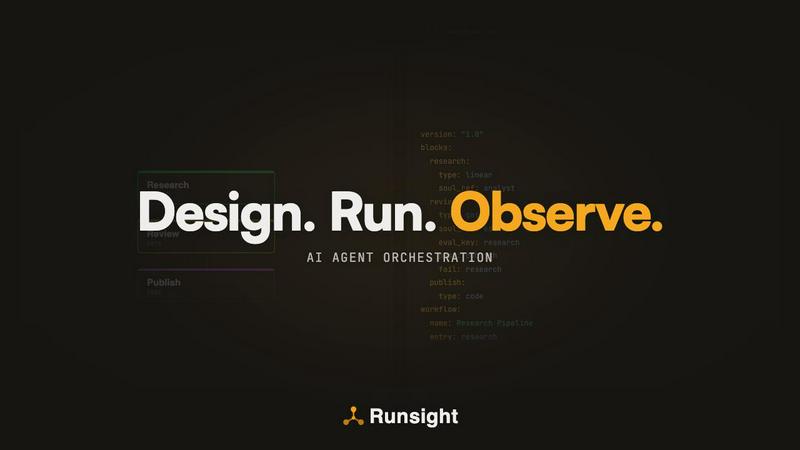
About Runsight
Runsight is an innovative visual development environment specifically designed for AI engineers to create, manage, and observe multi-agent workflows. By seamlessly integrating YAML workflows with Git, Runsight allows users to design agent workflows that are not only visually intuitive but also version-controlled and maintainable. This unique approach means that every workflow is saved as a YAML file in your Git repository, making it easy to track changes, review modifications, and deploy through existing CI/CD pipelines. The platform prioritizes transparency and control, eliminating vendor lock-in by ensuring that workflows are stored in standard formats rather than proprietary databases. With features like runtime intervention, budget enforcement, and a built-in evaluation framework, Runsight empowers engineering teams to orchestrate AI agents efficiently, enabling them to focus on innovation rather than configuration management.
Features of Runsight
Bidirectional Canvas-YAML Sync
Runsight offers a unique bidirectional sync between its visual canvas and YAML code. Users can edit workflows either visually or through code, with changes reflected in real-time across both platforms, ensuring that the workflow remains consistent and up to date.
Git-Native Persistence
All workflows created in Runsight are saved as YAML files within your Git repository. This approach allows for easy version control, enabling users to track changes, review modifications, and collaborate effectively—just like with any other code in their projects.
Runtime Intervention
One of the standout features of Runsight is the ability to pause a running workflow. This allows users to inspect the current state, troubleshoot issues, and fix problems without needing to restart the entire process, saving both time and resources.
Built-In Evaluation Harness
Runsight includes a built-in evaluation framework that facilitates offline testing of agent behavior. Users can use fixtures and structured assertions to validate outputs, ensuring that workflows produce the expected results and allowing for regression testing across runs.
Use Cases of Runsight
Streamlined AI Development
Engineering teams can use Runsight to streamline the development of AI agents by visually designing workflows. This visual approach simplifies the process of orchestrating complex interactions between multiple agents, leading to faster iterations and improved collaboration.
Cost Management in AI Workflows
With per-run cost tracking, Runsight enables teams to set budget caps for workflows. This feature helps prevent unexpected expenses by allowing users to monitor costs in real-time and take action before overspending, making it easier to manage project budgets.
Debugging and Troubleshooting
Runsight enhances debugging capabilities by allowing users to pause workflows and inspect them at any point. This feature significantly reduces the time spent on troubleshooting, as teams can immediately address issues without having to replay entire workflows.
Research and Development Pipelines
Researchers can leverage Runsight to create structured workflows for testing hypotheses and processing data. By utilizing the built-in evaluation harness, they can validate results and ensure that their AI models perform as intended before deployment.
Frequently Asked Questions
How does Runsight ensure no vendor lock-in?
Runsight stores all workflows as YAML files in your Git repository, which means you retain full control over your data. If Runsight were to become unavailable, you can still access and edit your workflows just like any other code.
Can I run Runsight locally?
Yes, Runsight is designed to be self-hosted, allowing users to run the platform on their own machines. You have complete control over your API keys and models, ensuring that your data remains secure within your network.
What types of workflows can I create with Runsight?
Runsight supports a variety of workflows tailored for AI agents, including LLM calls, quality gates, code execution, loops, and sub-workflows. This versatility enables users to address a wide range of use cases effectively.
Is Runsight open source?
Absolutely! Runsight is open source, meaning that anyone can access the code, contribute to its development, and customize it to fit their specific needs. This transparency fosters a collaborative community around the platform.
Explore more in this category:
Similar to Runsight

VoiceVibe
Talk to your computer: dictate, rewrite, ask about your screen, launch AI agents.

BlazePhoenix
On-chain DEX aggregator: the swap route is computed inside the transaction that executes it. No API key, no signup.

Booksmaker.ai
Books Maker AI is the AI-powered platform that turns your idea into a professional book.

Toolara Music
Describe a song in plain text and get a complete track — vocals or instrumental, custom lyrics, up to 120 seconds, MP3 download

AFFLIGO
AFFLIGO is a free online toolkit for everyday file tasks. Easily edit PDFs, compress images, convert file formats, and get things done.

SightRadar
Face recognition API, a drop-in replacement for AWS Rekognition. Index, search, compare and detect faces, billed per photo with no subscription.


LinkIntel
MCP server giving your AI assistant your X post results and X’s ranking weights, with sources.