
Agenta vs HookMesh
Side-by-side comparison to help you choose the right AI tool.

Agenta streamlines LLM app development with collaboration, prompt management, and clear evaluation to boost reliability.
Last updated: March 1, 2026

HookMesh adds reliable webhook delivery and a customer portal to your SaaS in minutes.
Last updated: February 28, 2026
Visual Comparison
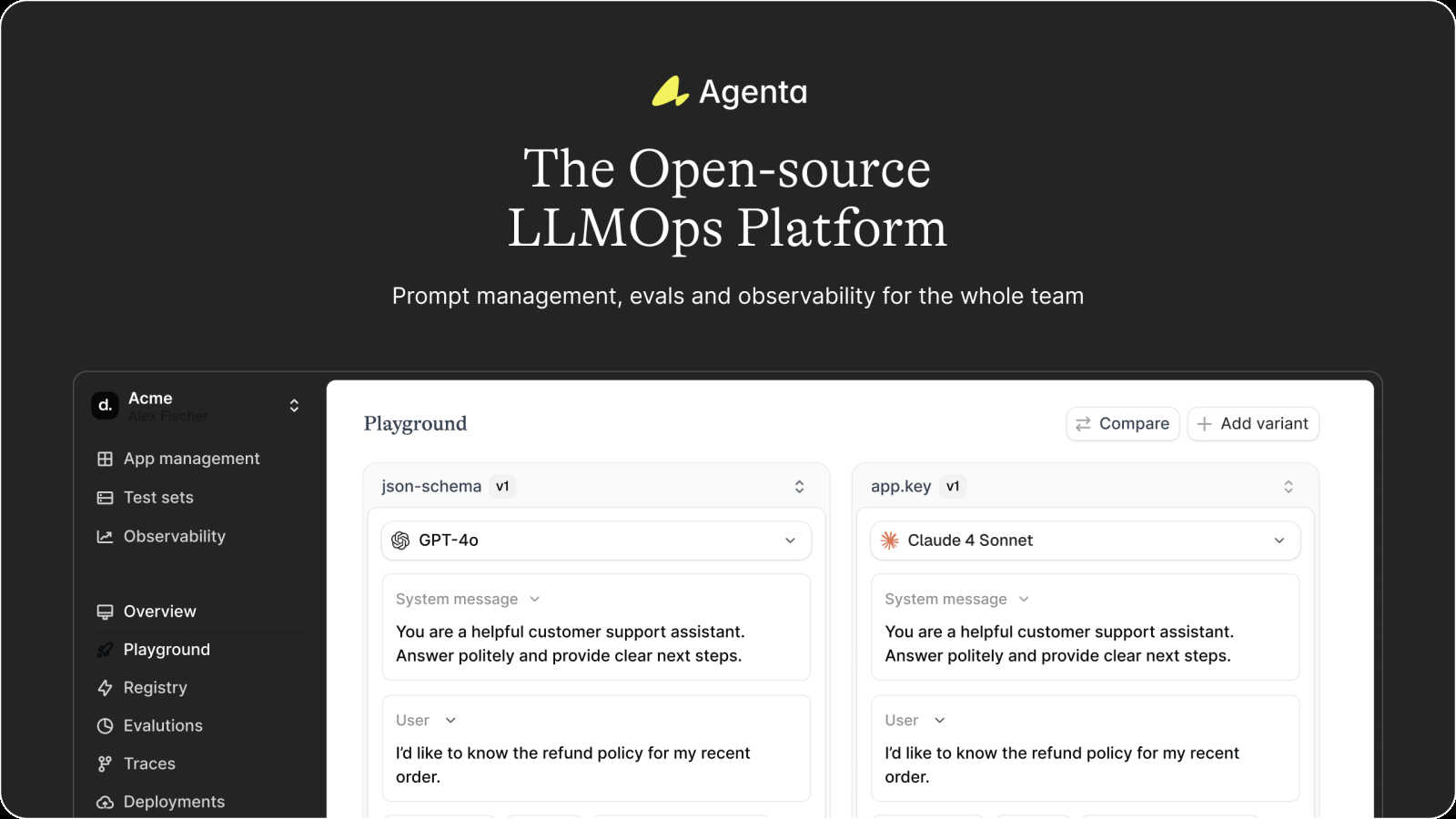
Agenta
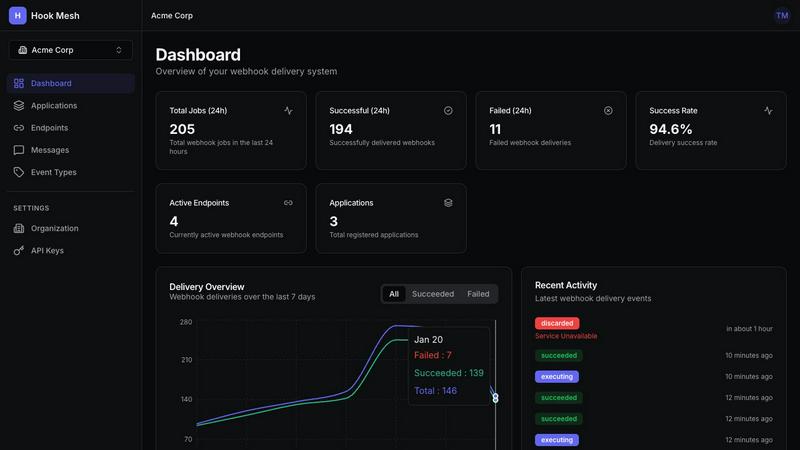
HookMesh
Feature Comparison
Agenta
Centralized Prompt Management
Agenta offers a unified platform to centralize all prompts, evaluations, and traces in one location. This eliminates the chaos of scattered documents and communications, providing a single source of truth for the entire team.
Collaborative Evaluation Environment
With Agenta, teams can create and monitor evaluations collaboratively. This feature enables users to run systematic and automated evaluations, providing a structured process to validate performance and gather insights effectively.
Integrated Observability Tools
Agenta features robust observability tools that allow teams to trace every request and pinpoint failure points with precision. This enhances the debugging process, making it easier to identify and resolve issues in production quickly.
Human-Centric Experimentation
Agenta empowers domain experts to safely edit and experiment with prompts without needing to dive into code. This collaborative approach allows product managers and subject matter experts to contribute actively to the evaluation and improvement of AI applications.
HookMesh
Reliable Delivery Engine
HookMesh's core is a robust delivery system designed to never lose a webhook. It employs automatic retries with exponential backoff and jitter, persistently trying to deliver each event for up to 48 hours. A smart circuit breaker automatically disables endpoints that are consistently failing to prevent them from backing up your queue, and re-enables them once they recover. Combined with at-least-once delivery guarantees and idempotency keys, you can trust that every critical event reaches its destination.
Customer Self-Service Portal
Transform webhook management from a support burden into a customer empowerment tool. HookMesh provides an embeddable UI portal that your customers can access to add, update, or remove their own webhook endpoints. They get full visibility with detailed delivery logs showing every request and response, and the powerful ability to replay any failed webhook instantly with just one click. This drastically reduces "Where's my webhook?" support tickets.
Developer-Friendly SDKs & API
Ship webhooks in minutes, not weeks. HookMesh offers a clean, well-documented REST API for full programmatic control, along with official, easy-to-use SDKs for popular languages like JavaScript, Python, and Go. Simply install the library, initialize it with your API key, and send events with a single function call. We handle all the complexity of delivery, retries, and failures behind the scenes.
Testing Playground & Tools
Before going live, you can test your webhook flows thoroughly using HookMesh's built-in Playground. This allows you to simulate events and debug integrations in a safe environment. Additionally, HookMesh provides helpful public tools like a Webhook Tester and Signature Validator, making the entire development and troubleshooting process smoother for everyone on your team.
Use Cases
Agenta
Streamlined Team Collaboration
Agenta serves as a central hub where product managers, developers, and domain experts can work together seamlessly. This collaboration fosters an environment of innovation, driving the development of more effective LLM applications.
Efficient Prompt Iteration
Using Agenta, teams can rapidly iterate on prompts while tracking changes and comparing different models side-by-side. This feature allows for quick experimentation, which is essential in optimizing LLM performance.
Systematic Performance Evaluation
Agenta enables teams to replace guesswork with evidence-based evaluations. By systematically tracking results and validating every change, teams can ensure that their models are continually improving.
Enhanced Debugging Processes
With Agenta’s observability features, teams can quickly debug their AI systems by tracing requests and identifying failure points. This significantly reduces the time spent on troubleshooting and enhances overall system reliability.
HookMesh
SaaS Product Notifications
Any SaaS platform that needs to notify external systems about events (e.g., "invoice.paid", "user.created", "project.updated") is a perfect fit. Instead of building a fragile in-house system, developers can integrate HookMesh once and reliably push all customer notifications, ensuring partners and users receive real-time data for their workflows and integrations.
E-commerce Order Processing
E-commerce platforms can use HookMesh to instantly notify warehouse management, shipping providers, CRM systems, or accounting software when an order is placed, fulfilled, or canceled. Reliable delivery is critical here; a lost "order.placed" webhook could mean a lost sale. HookMesh's guaranteed delivery ensures every step in the supply chain is triggered accurately.
Financial Tech and Payment Processing
Fintech apps handling sensitive payment events require absolute reliability and auditability. HookMesh delivers "payment.succeeded" or "transfer.completed" events to banking partners, fraud detection services, or user dashboards with guaranteed at-least-once delivery and full logs. The customer portal also allows business clients to manage their own webhook endpoints for reconciliation.
Internal Event-Driven Architecture
Teams can even use HookMesh internally to decouple their own services. Instead of managing direct service-to-service HTTP calls, different microservices can publish events to HookMesh, which then reliably fans them out to various subscribing internal endpoints. This improves system resilience and simplifies debugging with HookMesh's centralized logging.
Overview
About Agenta
Agenta is an innovative open-source LLMOps platform tailored for AI teams that aspire to develop and deploy reliable, production-ready large language model (LLM) applications. In a landscape where large language models can be highly unpredictable, Agenta addresses a critical challenge faced by many teams: the lack of structured processes to manage the complexities of AI development. Often, prompts are dispersed across various communication channels such as emails, Slack, and Google Sheets, leading to fragmented workflows. Agenta brings together developers, product managers, and subject matter experts in a collaborative hub where they can experiment, evaluate, and debug LLM applications with ease. By centralizing prompt management, evaluation, and observability, Agenta ensures that teams can transition from chaotic practices to systematic LLMOps best practices. This facilitates a quicker iteration process while instilling confidence in the reliability and performance of AI applications, allowing teams to innovate without the fear of unpredictable outcomes.
About HookMesh
HookMesh is a developer-first platform that takes the pain out of building and managing webhooks for SaaS products. If you've ever tried to build webhooks in-house, you know the hidden complexities: crafting robust retry logic, implementing circuit breakers, and spending countless hours debugging why a webhook didn't arrive. HookMesh solves all of that. It provides a battle-tested infrastructure that guarantees reliable webhook delivery so you can focus on your core product, not on infrastructure headaches. The platform is designed for developers and product teams who need to provide seamless, real-time integrations for their customers. Its standout value proposition is a powerful combination of "set it and forget it" reliability for you, and a self-service portal for your customers. This means your engineering team saves months of development time, while your end-users get full visibility into webhook deliveries, can manage their own endpoints, and replay failures with a single click. With HookMesh, you add enterprise-grade webhook functionality in minutes, not months, ensuring peace of mind for both your team and your customers.
Frequently Asked Questions
Agenta FAQ
What types of teams can benefit from using Agenta?
Agenta is designed for AI development teams, including developers, product managers, and domain experts, who want to collaborate effectively in building reliable LLM applications.
How does Agenta improve collaboration among team members?
By centralizing prompts, evaluations, and observability in one platform, Agenta fosters collaboration among various roles, allowing teams to work together more efficiently and effectively.
Can Agenta be integrated with existing tools and frameworks?
Yes, Agenta seamlessly integrates with a wide range of tools and frameworks, including LangChain, LlamaIndex, and OpenAI. This flexibility ensures that teams can leverage their existing tech stack while benefiting from Agenta's features.
What makes Agenta different from other LLMOps platforms?
Agenta stands out due to its open-source nature, commitment to collaboration, and its comprehensive approach to prompt management, evaluation, and observability, all in a single platform designed for the entire LLM development lifecycle.
HookMesh FAQ
How does HookMesh ensure webhooks are delivered?
HookMesh uses a multi-layered approach for reliability. Every webhook is queued and sent with automatic retries that use exponential backoff and jitter for up to 48 hours. If an endpoint is repeatedly failing, our circuit breaker temporarily disables it to protect your system's queue. We also attach idempotency keys to prevent duplicate processing on the receiver's side, guaranteeing at-least-once delivery.
Can my customers manage their own webhook endpoints?
Absolutely! This is one of HookMesh's key features. You can embed our white-labeled customer portal directly into your application. From there, your customers can add, edit, or delete their webhook endpoints, view complete logs of all delivery attempts (including request and response data), and instantly replay any failed webhook with a single click, all without needing to contact your support team.
Is there a free plan to try it out?
Yes! HookMesh offers a generous Free tier that includes 5,000 webhooks per month at no cost. This plan includes all core reliability features (retries, circuit breaker) and the customer portal, with 7-day log retention. It's perfect for getting started, testing, and small projects. No credit card is required to sign up and begin using the service.
What happens if we exceed our monthly webhook limit?
If you exceed the limit on your paid plan, HookMesh will continue to deliver your webhooks without interruption. Overage charges are applied on a per-webhook basis at a transparent rate, which you can view on our full pricing page. This ensures you never experience a service disruption during unexpected traffic spikes. You can also upgrade your plan at any time.
Alternatives
Agenta Alternatives
Agenta is an open-source platform designed for LLMOps, helping teams collaborate effectively in building and managing reliable large language model applications. By centralizing tasks like prompt management, evaluation, and observability, Agenta addresses the complexities of AI development, ensuring teams can work cohesively rather than in silos. Users often seek alternatives to Agenta for various reasons, including pricing constraints, specific feature sets, or compatibility with existing workflows. When considering alternatives, it's essential to look for platforms that offer similar collaboration capabilities, robust evaluation frameworks, and flexibility in experimenting with multiple LLM models, ensuring they meet the unique needs of your team.
HookMesh Alternatives
HookMesh is a specialized platform in the developer tools category, designed to handle the heavy lifting of webhook delivery for SaaS companies. It takes care of reliability, retries, and customer management so your team doesn't have to build this complex infrastructure from scratch. Users often explore alternatives for various reasons. This could be due to specific budget constraints, a need for different feature sets, or a requirement to integrate with a particular tech stack or cloud platform. It's a normal part of finding the perfect fit for your product's unique needs. When evaluating other options, focus on a few key areas. Look for robust reliability guarantees, tools that give your customers visibility and control, and a strong developer experience that saves your team time instead of creating more work.