
Banana Editor vs dmaya
Side-by-side comparison to help you choose the right AI tool.

Banana Editor
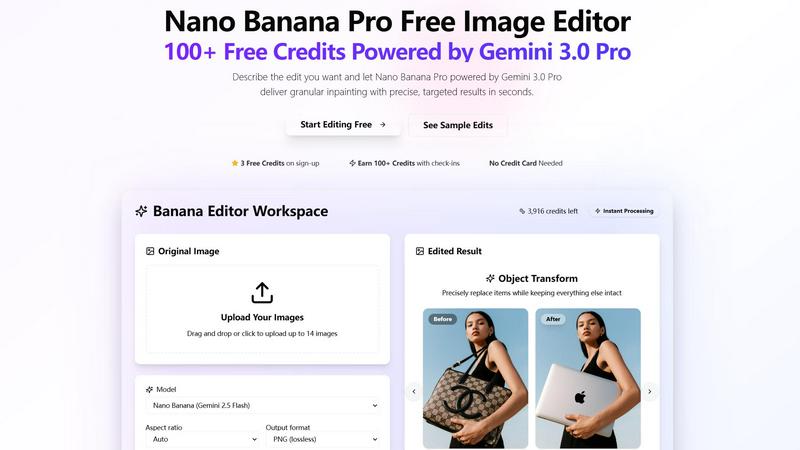
Banana Editor transforms your photos with simple text prompts for precise edits like background removal and relighting.
Last updated: March 1, 2026

dmaya
dMaya is the AI design platform for agencies to generate, iterate, and export client-ready UI designs at the speed of thought.
Last updated: April 13, 2026
Visual Comparison
Banana Editor
dmaya
Feature Comparison
Banana Editor
Prompt-Driven Editing with Nano Banana Pro
Simply describe the edit you want in plain English, and the powerful Nano Banana Pro (Gemini 3.0 Pro) model brings it to life. This feature removes the steep learning curve of traditional photo editing, allowing you to execute complex instructions like background replacements, object additions, or lighting changes just by typing a sentence. It delivers granular inpainting, meaning it can target specific areas of an image with surgical precision while leaving everything else untouched.
Precise Object Transformation
This feature is perfect for detailed product or fashion edits. You can instruct the AI to precisely replace or modify specific items within a scene. For example, you can swap a handbag for a laptop on a model's shoulder or change a bottle's label. The AI intelligently understands the context, ensuring the new object blends seamlessly with the original lighting, perspective, and shadows, keeping the rest of the composition perfectly intact.
Flexible Output & Workspace Controls
Banana Editor gives you full control over your final image's specifications. Before applying your edit, you can select the desired aspect ratio (from square 1:1 to vertical 9:16), output format (PNG, JPEG, WebP), and resolution (up to 4K). This ensures your edited image is perfectly optimized for its intended use, whether it's a social media post, a product catalog page, or a wide-format banner ad, all from within one intuitive workspace.
Inspiration Gallery & Prompt Remixing
Jumpstart your creativity with a community-driven gallery of sample edits. Browse through categorized examples like "E-commerce Product Photos" or "Cinematic Posters" to see what's possible. Each example comes with the exact prompt used, which you can copy and remix for your own images. This feature is an excellent way to learn effective prompting techniques and instantly apply proven creative concepts to your projects.
dmaya
Conversational AI Design Generation
Start your project by simply describing what you need. Whether it's a complex SaaS dashboard or a simple landing page, dMaya's AI understands your text prompt and generates complete, production-ready UI designs within seconds. This includes full layouts, a coherent component system, and responsive variants, giving you a professional starting point that you can then refine through natural conversation.
Multi-Screen Infinite Canvas
Work the way you think, across multiple screens and device types. dMaya provides an infinite canvas where you can manage desktop, tablet, and mobile frames simultaneously. Drag, zoom, and organize screens intuitively, similar to traditional design tools like Figma, but supercharged with AI that handles the heavy lifting of initial creation and consistent updates across all your artboards.
Client Presentation & Feedback Loop
Eliminate lengthy email threads and confusing screenshot markups. With dMaya, you generate a single, shareable link to an interactive preview of your designs. Clients and stakeholders can view it directly in their browser, leave precise feedback as comments, and approve designs—all without needing to create an account. This streamlines the review cycle from days down to mere minutes.
Design-to-Code Export for AI Agents
When your design is client-approved, dMaya doesn't leave you hanging. Export your screens as clean, well-structured HTML, CSS, and JavaScript code. This output is perfectly formatted to be handed directly to AI coding assistants like Claude Code or Cursor, which can then transform it into production-ready code for your chosen framework, be it React, Next.js, or Flutter.
Use Cases
Banana Editor
Content & Social Media Creation
Ideal for influencers and social media managers, Banana Editor streamlines content creation. You can lock a subject's identity across a series of posts, instantly swap backgrounds to match seasonal themes, or add branded props to images without organizing a reshoot. The granular editing ensures every post looks cohesive and professionally tailored, saving hours of manual editing time for stories, reels, and carousels.
E-commerce & Product Photography
Transform your online catalog efficiently. Update product photos in batches by swapping scenes or backgrounds for a fresh look. Instantly generate new product colorways, update packaging labels for a campaign, or create perfectly cropped images for different platform requirements. This allows e-commerce teams to keep their visuals current and engaging without the cost and time of new photoshoots for every minor change.
Interiors & Real Estate Staging
Visualize redesigns and property staging with ease. Rearrange virtual furniture in a room, change wall colors or flooring materials realistically, or adjust the lighting from a bright day to a cozy evening ambiance. This use case is invaluable for interior designers, real estate agents, and homeowners looking to experiment with different styles and present compelling visualizations to clients.
Film & Marketing Previsualization
Perfect for creative teams in advertising and film, Banana Editor acts as a powerful pre-visualization tool. Directors and marketers can quickly generate alternate costumes, experiment with set dressings, or create mock-ups of key visual scenes for storyboards and mood boards. This accelerates the creative decision-making process and helps align teams on a visual direction before moving to costly production stages.
dmaya
Agency Pitch & Concept Development
Agencies can use dMaya to dramatically speed up their client acquisition process. During a discovery call, designers can generate live visual concepts based on the client's description, presenting multiple polished directions in hours instead of weeks. This ability to visualize ideas instantly helps win more business by demonstrating capability and understanding immediately.
Product Team Ideation & Alignment
Product teams can leverage dMaya to explore UI directions and user flows before committing valuable engineering resources. Designers, product managers, and engineers can collaborate in a single workspace to iterate on visuals, ensuring everyone is aligned on the vision. This reduces costly miscommunication and rework later in the development cycle.
Freelancer Project Scaling
Freelancers can take on more client work and increase their value without working exponentially more hours. dMaya allows them to generate professional-grade designs rapidly, iterate quickly based on client feedback via shareable links, and deliver a superior final product that includes ready-to-build code assets, enabling them to charge premium rates.
Design System & Prototype Creation
Teams looking to establish or expand a design system can use dMaya as a powerful starting point. Describe core components like buttons, cards, or navigation bars, and use the conversational AI to ensure visual consistency (colors, spacing, typography) across all generated screens. This creates a cohesive prototype that serves as a single source of truth for both design and development.
Overview
About Banana Editor
Banana Editor is a revolutionary AI-powered image editing platform that transforms how you edit photos. At its core, it uses the advanced Gemini 3.0 Pro (Nano Banana Pro) technology to understand your creative vision through simple text prompts. Instead of navigating complex software tools, you just upload an image and describe the change you want—like "replace the background with a sunset" or "swap the model's shirt for a blue jacket"—and Banana Editor executes it with impressive precision. It's built for anyone who needs high-quality visual edits quickly and efficiently, from social media creators and e-commerce managers to marketing teams and interior designers. The main value proposition is its "granular inpainting" capability, which allows for targeted edits that keep all other parts of the image perfectly intact, ensuring professional, stable results. Best of all, you can start for free with credits earned simply by signing up and checking in, with no credit card required, making professional-grade editing accessible to everyone.
About dmaya
dMaya is an AI-powered design platform built specifically for professional workflows where visual design and client approval come before a single line of code is written. It's the answer for agencies, product teams, and freelancers who feel that modern AI tools skip the crucial design phase, rushing straight to code generation without room for iteration and stakeholder alignment. With dMaya, you describe your vision for a SaaS dashboard, e-commerce flow, or mobile app in plain language, and its AI agent generates polished, professional UI screens in seconds. The magic happens in the conversation: you can chat with the AI to iterate on colors, layouts, typography, and components, with every change applied instantly while design tokens keep everything consistent. Once the design is refined, you share a simple preview link with clients for feedback and approval—no accounts needed for them, turning a process that used to take days into minutes. Finally, export your approved designs as clean HTML, CSS, and JS to hand off to AI coding agents like Cursor or Claude Code for development in React, Next.js, Flutter, or any other framework. dMaya empowers teams to design intentionally, present confidently, and ship with certainty.
Frequently Asked Questions
Banana Editor FAQ
How do I get started and is it really free?
Yes, you can start editing for free immediately! Simply sign up for an account and you'll receive free credits to begin using Banana Editor. No credit card is required upfront. You can also earn more credits through daily check-ins on the platform, providing a sustainable way to access the tool's core features without an initial financial commitment.
What is "granular inpainting"?
Granular inpainting is the advanced AI technology that allows Banana Editor to make extremely precise edits to specific parts of your image. Instead of regenerating the entire picture, the AI identifies and alters only the area you describe in your prompt, keeping all other details—like the subject's face, the surrounding environment, and the original lighting—completely stable and unchanged. This results in clean, realistic before-and-after comparisons.
What kind of edits can I make with a text prompt?
You can make a wide variety of edits by describing them. Common examples include replacing or removing backgrounds, swapping clothing or accessories on a person, changing object colors, modifying lighting conditions (e.g., to "golden hour"), adding new elements like props, extending image canvases for different formats, and updating text on labels or signs. The more descriptive your prompt, the better the result.
Can I use the edited images for commercial purposes?
Yes, you own the images you create using Banana Editor. The platform is designed to support professional workflows for content creators, marketers, and e-commerce businesses. The images you generate or edit are yours to use in commercial projects, social media, advertising, product listings, and other business applications. Always ensure any original images you upload have the appropriate rights for modification.
dmaya FAQ
Who is dMaya built for?
dMaya is purpose-built for professional designers, agencies, product teams, and freelancers who follow a design-first workflow. It's for teams that need to create, present, and get client approval on visual designs before any development begins. It's not for solo enthusiasts looking to immediately generate full, functional applications without a design phase.
How does the AI design iteration work?
You interact with dMaya through a chat interface. After your initial design is generated, you can type requests like "make the primary color blue," "swap the sidebar to the right," "use a more modern font," or "add a testimonial section." The AI understands these natural language commands and applies the changes precisely and instantly to your design, maintaining consistency automatically.
What kind of code does dMaya export?
dMaya exports clean, vanilla front-end code: semantic HTML, CSS (with flexbox/grid for layout), and JavaScript for basic interactivity. This code is not framework-specific but is intentionally structured and commented to be easily ingested by AI coding agents (like Cursor or Claude Code) that can then convert it into React, Vue, Next.js, Flutter, or any other framework your team uses.
Do clients need an account to review designs?
No, clients and stakeholders do not need any account whatsoever. You simply send them a secure preview link generated within dMaya. They can open this link in any modern web browser, view the designs, leave comments directly on the canvas, and approve the work—all completely friction-free, which is key to getting fast and clear feedback.
Alternatives
Banana Editor Alternatives
Banana Editor is a modern, AI-powered photo editing tool in the design and image category. It stands out for its prompt-driven approach, allowing users to describe edits in plain language to remove backgrounds, swap outfits, and relight scenes with impressive control. People often explore other options for various reasons. They might need a tool with a different pricing model, specific advanced features not offered, or one that integrates directly into their existing platform or workflow. The search for the right fit is common. When evaluating alternatives, consider what matters most for your projects. Key factors include the core editing capabilities, the learning curve and user interface, the cost structure and value, and how well the tool handles the specific types of image manipulation you do regularly.
dmaya Alternatives
dMaya is an AI-powered vibe design platform that helps agencies, teams, and freelancers create professional UI designs through conversation. It sits at the intersection of design and development tools, focusing on the crucial visual design step before coding begins. Users can describe an interface, iterate with an AI, get client approval, and export clean code. People often look for alternatives to a tool like dmaya for various reasons. This could be due to budget constraints, a need for different feature sets like more advanced prototyping or native app integrations, or a preference for a different workflow style. Some teams might require tools that are part of a larger ecosystem they already use. When evaluating other options, consider what matters most for your projects. Key factors include the quality and control of the AI design output, the efficiency of the client feedback and approval process, and the cleanliness and flexibility of the exported code. The right tool should fit seamlessly into your team's process from concept to handoff.