
diffray vs Fallom
Side-by-side comparison to help you choose the right AI tool.

diffray
Diffray uses multi-agent AI to review your code, catching real bugs with far fewer false alarms.
Last updated: February 28, 2026

Fallom gives you real-time observability to track, debug, and optimize your AI agents and LLM calls.
Last updated: February 28, 2026
Visual Comparison
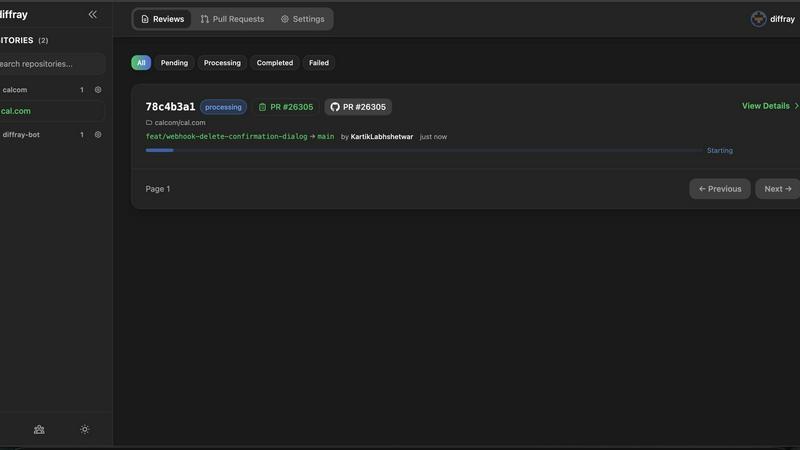
diffray
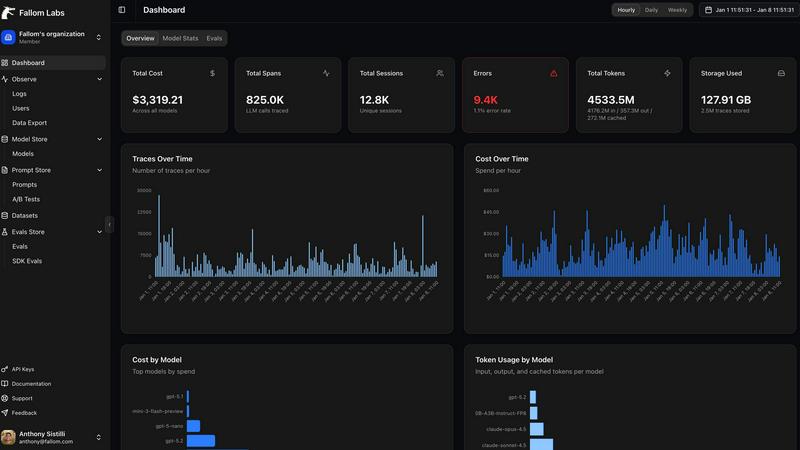
Fallom
Feature Comparison
diffray
Multi-Agent Specialized Architecture
Unlike tools that use one model for everything, diffray's powerhouse is its team of over 30 specialized AI agents. Think of it as having a dedicated security expert, a performance guru, a bug-detection specialist, and a best-practice coach all reviewing your code simultaneously. Each agent is finely tuned for its domain, which means feedback is highly relevant and deeply informed. This specialization is the key to minimizing generic, unhelpful comments and providing insights that are actually worth your time.
Context-Aware Code Analysis
diffray doesn't just look at lines of code in isolation. It understands the context of your entire codebase and the specific changes in your pull request. This allows it to distinguish between a legitimate issue and a false alarm that might be part of your project's unique patterns or architecture. By analyzing relationships and patterns, it delivers feedback that is accurate and actionable, telling you not just what might be wrong, but why it matters in your specific situation.
Drastic Reduction in False Positives
One of the most celebrated features is diffray's ability to cut false positives by 87%. This is a game-changer for developer experience. Instead of wasting precious time sifting through dozens of irrelevant warnings, your team can focus only on the signals that matter. This builds trust in the tool and ensures that when diffray highlights an issue, developers know it's something that genuinely requires attention, leading to faster and more confident reviews.
Comprehensive Issue Detection
While reducing noise, diffray simultaneously increases signal strength, identifying three times more real issues than conventional approaches. Its agents scan for a wide spectrum of concerns, from critical security flaws and memory leaks to subtle bugs, anti-patterns, and performance inefficiencies. This comprehensive coverage acts as a robust safety net, catching problems that might slip through manual review or be missed by less sophisticated tools.
Fallom
End-to-End LLM Tracing
Fallom provides comprehensive, granular tracing for every LLM interaction in your system. You can track the full journey of a request, including the exact prompt sent, the model's output, any tool or function calls made by an agent, token usage, latency, and the calculated cost. This complete visibility is essential for understanding performance, debugging unexpected behavior, and optimizing each call for better efficiency and lower expenses.
Real-Time Cost Attribution & Dashboard
Gain instant clarity on your AI spending with Fallom's live dashboard. It automatically breaks down costs by model, user, team, or customer, turning opaque API bills into actionable insights. You can see a live feed of calls, monitor for spending anomalies, and attribute expenses accurately for internal chargebacks or client billing, ensuring full financial transparency and control over your AI budget.
Compliance-Ready Audit Trails
Built for regulated industries, Fallom creates immutable, detailed audit logs of every AI interaction. It supports critical compliance needs like model versioning, user consent tracking, and input/output logging, helping you meet requirements for standards like the EU AI Act, SOC 2, and GDPR. This feature provides the necessary documentation to demonstrate responsible AI usage and data handling.
Timing Waterfall & Tool Call Visibility
Debug complex, multi-step agent workflows with ease using Fallom's visual timing waterfall diagrams. These charts break down the exact sequence and duration of LLM calls, tool executions, and processing steps, making it simple to pinpoint latency bottlenecks. Coupled with deep visibility into every tool call—showing function names, arguments, and results—you can quickly identify and fix inefficiencies in your agentic chains.
Use Cases
diffray
Accelerating Pull Request Workflows
Development teams can integrate diffray directly into their GitHub or GitLab workflows to act as a first-line reviewer. As soon as a pull request is opened, diffray's agents get to work, providing detailed, categorized feedback within minutes. This allows human reviewers to start their review with a clear list of potential issues already identified, cutting the average review time from 45 minutes to just 12 minutes and dramatically speeding up the merge process.
Onboarding New Team Members
For new developers joining a project, understanding the codebase's standards and catching subtle mistakes can be challenging. diffray serves as an always-available mentor, reviewing their code against the project's best practices and security norms. This provides immediate, constructive feedback, helps enforce consistency, and accelerates the onboarding process by teaching best practices through direct, contextual examples.
Enhancing Code Quality and Security
Teams aiming to proactively improve their code health and security posture use diffray as a continuous guardrail. With its specialized security and best-practice agents, it automatically scans every change for vulnerabilities like SQL injection, insecure dependencies, or sensitive data exposure. This shift-left approach embeds quality and security checks directly into the developer's workflow, preventing issues from reaching production.
Supporting Solo Developers and Freelancers
Even developers working alone benefit immensely from a second pair of "eyes." diffray acts as a reliable coding partner for freelancers and indie developers, offering expert-level reviews that would otherwise require a colleague. It helps catch bugs, optimize performance, and ensure clean code before delivery, increasing the quality and reliability of work delivered to clients without the need for a full team.
Fallom
Optimizing AI Agent Performance
Development teams use Fallom to monitor and debug their production AI agents. By analyzing timing waterfalls and tool call traces, engineers can identify why an agent is slow—perhaps a specific database query or external API call is lagging—and optimize the workflow to improve response times and user experience significantly.
Managing and Forecasting AI Costs
Finance and engineering leaders leverage Fallom's cost attribution features to track spending across different projects, teams, and models. This allows for accurate budgeting, forecasting, and internal chargebacks. Teams can identify if a specific feature or user is driving unexpected costs and take action, such as optimizing prompts or switching models, to stay within budget.
Ensuring Regulatory Compliance
Compliance and legal officers in healthcare, finance, or enterprise software use Fallom to maintain robust audit trails for AI systems. The platform logs all necessary data (inputs, outputs, model versions, user consent) in an immutable format, providing the evidence needed to pass security audits and demonstrate adherence to industry regulations and internal governance policies.
Improving LLM Application Reliability
SRE and DevOps teams implement Fallom for real-time monitoring and alerting on their LLM-powered applications. By watching the live dashboard for error spikes, latency increases, or hallucination rate changes, they can detect and resolve incidents proactively before they impact end-users, ensuring high reliability and uptime for critical AI services.
Overview
About diffray
diffray is a revolutionary AI-powered code review assistant designed to transform how developers and engineering teams handle pull requests. At its core, diffray tackles the biggest pain point of traditional AI review tools: overwhelming noise and irrelevant feedback. Instead of relying on a single, generic AI model that often cries wolf, diffray employs an intelligent multi-agent architecture. This system features over 30 specialized AI agents, each an expert in a critical area like security vulnerabilities, performance bottlenecks, bug patterns, coding best practices, and even SEO for web projects. This targeted approach allows diffray to understand the specific context of your code changes, delivering precise, actionable insights. The result is a staggering 87% reduction in false positives while uncovering three times more genuine, critical issues. For teams, this means slashing the average time spent on pull request reviews from 45 minutes to just 12 minutes per week. diffray is built for development teams of all sizes who are serious about improving code quality, boosting team productivity, and fostering a more collaborative and efficient review process without the clutter and frustration of inaccurate alerts.
About Fallom
Fallom is your all-in-one observability platform built from the ground up for the age of AI. It's designed to bring crystal-clear visibility to the complex world of large language models (LLMs) and AI agents running in production. Think of it as a powerful dashboard that lets you see every single LLM call, trace every step of an agent's reasoning, and understand exactly what's happening under the hood of your AI applications. For developers and data scientists, this means you can debug a slow or failing agent in minutes instead of hours. For product and business leaders, it provides crucial insights into costs, usage patterns, and performance to ensure your AI initiatives are efficient and scalable. Fallom empowers teams to move fast with confidence, offering enterprise-grade features like compliance-ready audit trails and detailed cost attribution right out of the box. With its OpenTelemetry-native SDK, you can start tracing your applications in under five minutes, making advanced AI observability accessible to every team.
Frequently Asked Questions
diffray FAQ
How does diffray achieve such a low false-positive rate?
diffray's multi-agent architecture is specifically designed for accuracy. Instead of one model trying to be an expert at everything, we have over 30 specialized agents. Each agent is an expert in a narrow field, like security or performance, and is trained to understand context. This deep specialization allows the system to make far more nuanced judgments, distinguishing between actual problems and acceptable code patterns, which leads to the 87% reduction in false alarms.
What programming languages and frameworks does diffray support?
diffray is built to support a wide range of modern programming languages and popular frameworks. While the exact list is continually expanding, it includes strong support for JavaScript/TypeScript, Python, Java, Go, Ruby, PHP, and their associated ecosystems and frameworks like React, Node.js, Django, and Spring. The best way to check for your specific stack is to connect your repository for a trial.
How does diffray integrate with our existing development tools?
diffray is designed for seamless integration into your existing workflow. It primarily connects directly with GitHub and GitLab, acting as a bot or app that automatically comments on your pull requests. There's no need to switch contexts or use a separate dashboard; the feedback appears right where your team already works, making adoption smooth and non-disruptive.
Is my source code kept private and secure with diffray?
Absolutely. Code security and privacy are our top priorities. diffray treats your code with the highest level of confidentiality. We use secure, encrypted connections for all data in transit, and we do not store your source code permanently after analysis. You retain full ownership of your code, and our systems are designed to analyze it only for the purpose of providing the review feedback you request.
Fallom FAQ
How quickly can I start using Fallom?
You can get started in under five minutes. Fallom uses a single, OpenTelemetry-native SDK that you integrate into your application. Once instrumented, traces will immediately begin flowing to your Fallom dashboard, requiring minimal setup or configuration to see your first data.
Does Fallom support all LLM providers?
Yes, Fallom is designed to be provider-agnostic. It works with every major LLM provider, including OpenAI, Anthropic, Google Gemini, and others via its OpenTelemetry foundation. This means you can monitor all your AI models from one unified platform without vendor lock-in.
How does Fallom handle sensitive or private data?
Fallom offers a Privacy Mode for sensitive deployments. This allows you to disable full content capture for prompts and responses, logging only the metadata (like timings, token counts, and costs) while redacting the actual text. You can configure these privacy controls per environment to balance observability with data security.
Can I use Fallom for A/B testing different models or prompts?
Absolutely. Fallom includes features for model A/B testing and a Prompt Store for version control. You can safely roll out a new model to a percentage of traffic or test different prompt variations, then use Fallom's analytics to compare their performance, cost, and quality metrics side-by-side before making a full switch.
Alternatives
diffray Alternatives
diffray is an AI-powered code review tool that helps development teams catch bugs and improve code quality. It stands out in the category of developer productivity tools by using a specialized multi-agent system to provide precise, actionable feedback. Developers often explore alternatives for various reasons. Budget constraints, specific feature needs like integration with a particular tech stack, or a desire for a different user experience are common drivers. It's a normal part of finding the perfect tool fit for a team's unique workflow and goals. When evaluating other options, focus on what matters most for your team. Key considerations include the accuracy of feedback to avoid wasting time on false positives, how well the tool understands your existing codebase for relevant suggestions, and the overall impact on your team's review speed and collaboration.
Fallom Alternatives
Fallom is a specialized observability platform for large language models (LLMs) and AI agents, falling into the development and AI operations category. It provides deep visibility into how your AI applications perform in production, tracking everything from prompts and costs to latency and tool calls. Users often explore alternatives for various reasons. These can include budget constraints, the need for a different feature set, or integration requirements with their existing tech stack. Some teams might be looking for a more general-purpose monitoring tool, while others may prioritize specific compliance or deployment options. When evaluating other solutions, it's wise to consider a few key areas. Look for robust LLM and agent tracing, clear cost attribution, and session-level context. Also, assess how easily it integrates into your workflow and whether it meets your specific security and compliance standards for audit trails.