
diffray vs HookMesh
Side-by-side comparison to help you choose the right AI tool.

diffray
Diffray uses multi-agent AI to review your code, catching real bugs with far fewer false alarms.
Last updated: February 28, 2026

HookMesh adds reliable webhook delivery and a customer portal to your SaaS in minutes.
Last updated: February 28, 2026
Visual Comparison
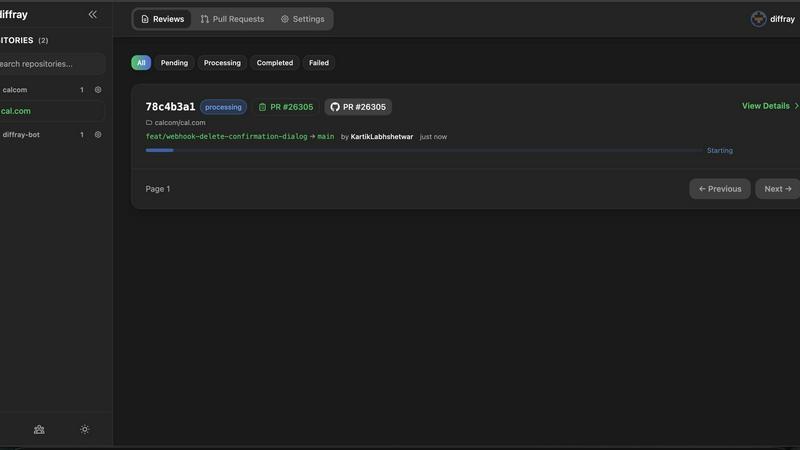
diffray
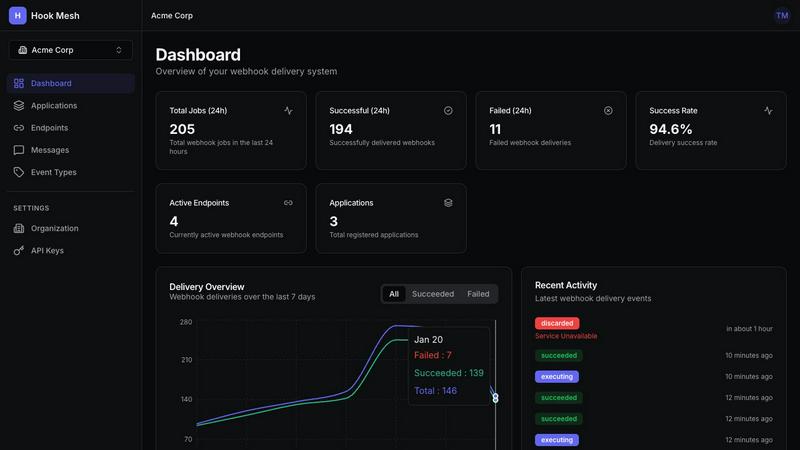
HookMesh
Feature Comparison
diffray
Multi-Agent Specialized Architecture
Unlike tools that use one model for everything, diffray's powerhouse is its team of over 30 specialized AI agents. Think of it as having a dedicated security expert, a performance guru, a bug-detection specialist, and a best-practice coach all reviewing your code simultaneously. Each agent is finely tuned for its domain, which means feedback is highly relevant and deeply informed. This specialization is the key to minimizing generic, unhelpful comments and providing insights that are actually worth your time.
Context-Aware Code Analysis
diffray doesn't just look at lines of code in isolation. It understands the context of your entire codebase and the specific changes in your pull request. This allows it to distinguish between a legitimate issue and a false alarm that might be part of your project's unique patterns or architecture. By analyzing relationships and patterns, it delivers feedback that is accurate and actionable, telling you not just what might be wrong, but why it matters in your specific situation.
Drastic Reduction in False Positives
One of the most celebrated features is diffray's ability to cut false positives by 87%. This is a game-changer for developer experience. Instead of wasting precious time sifting through dozens of irrelevant warnings, your team can focus only on the signals that matter. This builds trust in the tool and ensures that when diffray highlights an issue, developers know it's something that genuinely requires attention, leading to faster and more confident reviews.
Comprehensive Issue Detection
While reducing noise, diffray simultaneously increases signal strength, identifying three times more real issues than conventional approaches. Its agents scan for a wide spectrum of concerns, from critical security flaws and memory leaks to subtle bugs, anti-patterns, and performance inefficiencies. This comprehensive coverage acts as a robust safety net, catching problems that might slip through manual review or be missed by less sophisticated tools.
HookMesh
Reliable Delivery Engine
HookMesh's core is a robust delivery system designed to never lose a webhook. It employs automatic retries with exponential backoff and jitter, persistently trying to deliver each event for up to 48 hours. A smart circuit breaker automatically disables endpoints that are consistently failing to prevent them from backing up your queue, and re-enables them once they recover. Combined with at-least-once delivery guarantees and idempotency keys, you can trust that every critical event reaches its destination.
Customer Self-Service Portal
Transform webhook management from a support burden into a customer empowerment tool. HookMesh provides an embeddable UI portal that your customers can access to add, update, or remove their own webhook endpoints. They get full visibility with detailed delivery logs showing every request and response, and the powerful ability to replay any failed webhook instantly with just one click. This drastically reduces "Where's my webhook?" support tickets.
Developer-Friendly SDKs & API
Ship webhooks in minutes, not weeks. HookMesh offers a clean, well-documented REST API for full programmatic control, along with official, easy-to-use SDKs for popular languages like JavaScript, Python, and Go. Simply install the library, initialize it with your API key, and send events with a single function call. We handle all the complexity of delivery, retries, and failures behind the scenes.
Testing Playground & Tools
Before going live, you can test your webhook flows thoroughly using HookMesh's built-in Playground. This allows you to simulate events and debug integrations in a safe environment. Additionally, HookMesh provides helpful public tools like a Webhook Tester and Signature Validator, making the entire development and troubleshooting process smoother for everyone on your team.
Use Cases
diffray
Accelerating Pull Request Workflows
Development teams can integrate diffray directly into their GitHub or GitLab workflows to act as a first-line reviewer. As soon as a pull request is opened, diffray's agents get to work, providing detailed, categorized feedback within minutes. This allows human reviewers to start their review with a clear list of potential issues already identified, cutting the average review time from 45 minutes to just 12 minutes and dramatically speeding up the merge process.
Onboarding New Team Members
For new developers joining a project, understanding the codebase's standards and catching subtle mistakes can be challenging. diffray serves as an always-available mentor, reviewing their code against the project's best practices and security norms. This provides immediate, constructive feedback, helps enforce consistency, and accelerates the onboarding process by teaching best practices through direct, contextual examples.
Enhancing Code Quality and Security
Teams aiming to proactively improve their code health and security posture use diffray as a continuous guardrail. With its specialized security and best-practice agents, it automatically scans every change for vulnerabilities like SQL injection, insecure dependencies, or sensitive data exposure. This shift-left approach embeds quality and security checks directly into the developer's workflow, preventing issues from reaching production.
Supporting Solo Developers and Freelancers
Even developers working alone benefit immensely from a second pair of "eyes." diffray acts as a reliable coding partner for freelancers and indie developers, offering expert-level reviews that would otherwise require a colleague. It helps catch bugs, optimize performance, and ensure clean code before delivery, increasing the quality and reliability of work delivered to clients without the need for a full team.
HookMesh
SaaS Product Notifications
Any SaaS platform that needs to notify external systems about events (e.g., "invoice.paid", "user.created", "project.updated") is a perfect fit. Instead of building a fragile in-house system, developers can integrate HookMesh once and reliably push all customer notifications, ensuring partners and users receive real-time data for their workflows and integrations.
E-commerce Order Processing
E-commerce platforms can use HookMesh to instantly notify warehouse management, shipping providers, CRM systems, or accounting software when an order is placed, fulfilled, or canceled. Reliable delivery is critical here; a lost "order.placed" webhook could mean a lost sale. HookMesh's guaranteed delivery ensures every step in the supply chain is triggered accurately.
Financial Tech and Payment Processing
Fintech apps handling sensitive payment events require absolute reliability and auditability. HookMesh delivers "payment.succeeded" or "transfer.completed" events to banking partners, fraud detection services, or user dashboards with guaranteed at-least-once delivery and full logs. The customer portal also allows business clients to manage their own webhook endpoints for reconciliation.
Internal Event-Driven Architecture
Teams can even use HookMesh internally to decouple their own services. Instead of managing direct service-to-service HTTP calls, different microservices can publish events to HookMesh, which then reliably fans them out to various subscribing internal endpoints. This improves system resilience and simplifies debugging with HookMesh's centralized logging.
Overview
About diffray
diffray is a revolutionary AI-powered code review assistant designed to transform how developers and engineering teams handle pull requests. At its core, diffray tackles the biggest pain point of traditional AI review tools: overwhelming noise and irrelevant feedback. Instead of relying on a single, generic AI model that often cries wolf, diffray employs an intelligent multi-agent architecture. This system features over 30 specialized AI agents, each an expert in a critical area like security vulnerabilities, performance bottlenecks, bug patterns, coding best practices, and even SEO for web projects. This targeted approach allows diffray to understand the specific context of your code changes, delivering precise, actionable insights. The result is a staggering 87% reduction in false positives while uncovering three times more genuine, critical issues. For teams, this means slashing the average time spent on pull request reviews from 45 minutes to just 12 minutes per week. diffray is built for development teams of all sizes who are serious about improving code quality, boosting team productivity, and fostering a more collaborative and efficient review process without the clutter and frustration of inaccurate alerts.
About HookMesh
HookMesh is a developer-first platform that takes the pain out of building and managing webhooks for SaaS products. If you've ever tried to build webhooks in-house, you know the hidden complexities: crafting robust retry logic, implementing circuit breakers, and spending countless hours debugging why a webhook didn't arrive. HookMesh solves all of that. It provides a battle-tested infrastructure that guarantees reliable webhook delivery so you can focus on your core product, not on infrastructure headaches. The platform is designed for developers and product teams who need to provide seamless, real-time integrations for their customers. Its standout value proposition is a powerful combination of "set it and forget it" reliability for you, and a self-service portal for your customers. This means your engineering team saves months of development time, while your end-users get full visibility into webhook deliveries, can manage their own endpoints, and replay failures with a single click. With HookMesh, you add enterprise-grade webhook functionality in minutes, not months, ensuring peace of mind for both your team and your customers.
Frequently Asked Questions
diffray FAQ
How does diffray achieve such a low false-positive rate?
diffray's multi-agent architecture is specifically designed for accuracy. Instead of one model trying to be an expert at everything, we have over 30 specialized agents. Each agent is an expert in a narrow field, like security or performance, and is trained to understand context. This deep specialization allows the system to make far more nuanced judgments, distinguishing between actual problems and acceptable code patterns, which leads to the 87% reduction in false alarms.
What programming languages and frameworks does diffray support?
diffray is built to support a wide range of modern programming languages and popular frameworks. While the exact list is continually expanding, it includes strong support for JavaScript/TypeScript, Python, Java, Go, Ruby, PHP, and their associated ecosystems and frameworks like React, Node.js, Django, and Spring. The best way to check for your specific stack is to connect your repository for a trial.
How does diffray integrate with our existing development tools?
diffray is designed for seamless integration into your existing workflow. It primarily connects directly with GitHub and GitLab, acting as a bot or app that automatically comments on your pull requests. There's no need to switch contexts or use a separate dashboard; the feedback appears right where your team already works, making adoption smooth and non-disruptive.
Is my source code kept private and secure with diffray?
Absolutely. Code security and privacy are our top priorities. diffray treats your code with the highest level of confidentiality. We use secure, encrypted connections for all data in transit, and we do not store your source code permanently after analysis. You retain full ownership of your code, and our systems are designed to analyze it only for the purpose of providing the review feedback you request.
HookMesh FAQ
How does HookMesh ensure webhooks are delivered?
HookMesh uses a multi-layered approach for reliability. Every webhook is queued and sent with automatic retries that use exponential backoff and jitter for up to 48 hours. If an endpoint is repeatedly failing, our circuit breaker temporarily disables it to protect your system's queue. We also attach idempotency keys to prevent duplicate processing on the receiver's side, guaranteeing at-least-once delivery.
Can my customers manage their own webhook endpoints?
Absolutely! This is one of HookMesh's key features. You can embed our white-labeled customer portal directly into your application. From there, your customers can add, edit, or delete their webhook endpoints, view complete logs of all delivery attempts (including request and response data), and instantly replay any failed webhook with a single click, all without needing to contact your support team.
Is there a free plan to try it out?
Yes! HookMesh offers a generous Free tier that includes 5,000 webhooks per month at no cost. This plan includes all core reliability features (retries, circuit breaker) and the customer portal, with 7-day log retention. It's perfect for getting started, testing, and small projects. No credit card is required to sign up and begin using the service.
What happens if we exceed our monthly webhook limit?
If you exceed the limit on your paid plan, HookMesh will continue to deliver your webhooks without interruption. Overage charges are applied on a per-webhook basis at a transparent rate, which you can view on our full pricing page. This ensures you never experience a service disruption during unexpected traffic spikes. You can also upgrade your plan at any time.
Alternatives
diffray Alternatives
diffray is an AI-powered code review tool that helps development teams catch bugs and improve code quality. It stands out in the category of developer productivity tools by using a specialized multi-agent system to provide precise, actionable feedback. Developers often explore alternatives for various reasons. Budget constraints, specific feature needs like integration with a particular tech stack, or a desire for a different user experience are common drivers. It's a normal part of finding the perfect tool fit for a team's unique workflow and goals. When evaluating other options, focus on what matters most for your team. Key considerations include the accuracy of feedback to avoid wasting time on false positives, how well the tool understands your existing codebase for relevant suggestions, and the overall impact on your team's review speed and collaboration.
HookMesh Alternatives
HookMesh is a specialized platform in the developer tools category, designed to handle the heavy lifting of webhook delivery for SaaS companies. It takes care of reliability, retries, and customer management so your team doesn't have to build this complex infrastructure from scratch. Users often explore alternatives for various reasons. This could be due to specific budget constraints, a need for different feature sets, or a requirement to integrate with a particular tech stack or cloud platform. It's a normal part of finding the perfect fit for your product's unique needs. When evaluating other options, focus on a few key areas. Look for robust reliability guarantees, tools that give your customers visibility and control, and a strong developer experience that saves your team time instead of creating more work.