
Fallom vs Volume Shader BM
Side-by-side comparison to help you choose the right AI tool.

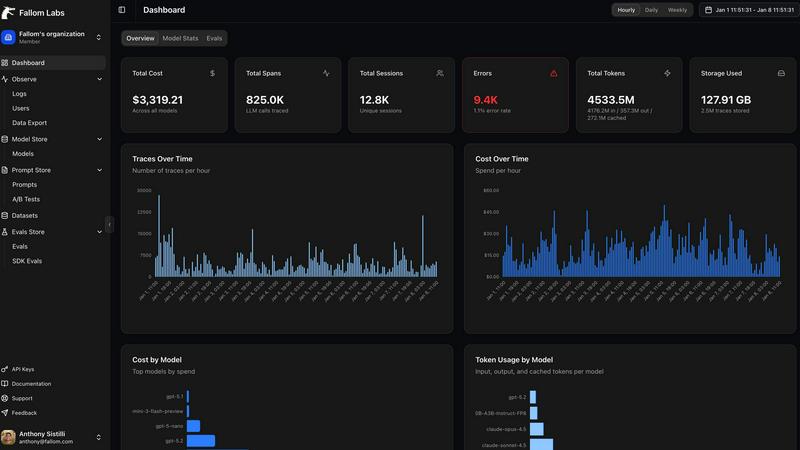
Fallom gives you real-time observability to track, debug, and optimize your AI agents and LLM calls.
Last updated: February 28, 2026
Unlock your GPU's true potential with our accurate, professional-grade performance testing tool.
Last updated: March 1, 2026
Visual Comparison
Fallom
Volume Shader BM

Feature Comparison
Fallom
End-to-End LLM Tracing
Fallom provides comprehensive, granular tracing for every LLM interaction in your system. You can track the full journey of a request, including the exact prompt sent, the model's output, any tool or function calls made by an agent, token usage, latency, and the calculated cost. This complete visibility is essential for understanding performance, debugging unexpected behavior, and optimizing each call for better efficiency and lower expenses.
Real-Time Cost Attribution & Dashboard
Gain instant clarity on your AI spending with Fallom's live dashboard. It automatically breaks down costs by model, user, team, or customer, turning opaque API bills into actionable insights. You can see a live feed of calls, monitor for spending anomalies, and attribute expenses accurately for internal chargebacks or client billing, ensuring full financial transparency and control over your AI budget.
Compliance-Ready Audit Trails
Built for regulated industries, Fallom creates immutable, detailed audit logs of every AI interaction. It supports critical compliance needs like model versioning, user consent tracking, and input/output logging, helping you meet requirements for standards like the EU AI Act, SOC 2, and GDPR. This feature provides the necessary documentation to demonstrate responsible AI usage and data handling.
Timing Waterfall & Tool Call Visibility
Debug complex, multi-step agent workflows with ease using Fallom's visual timing waterfall diagrams. These charts break down the exact sequence and duration of LLM calls, tool executions, and processing steps, making it simple to pinpoint latency bottlenecks. Coupled with deep visibility into every tool call—showing function names, arguments, and results—you can quickly identify and fix inefficiencies in your agentic chains.
Volume Shader BM
Advanced Volume Shader Technology
At its core, Volume Shader BM uses cutting-edge volume rendering algorithms to thoroughly stress your GPU's shader units. It creates intricate 3D scenes with complex lighting, shadows, and particle effects, simulating the demanding graphical workloads of the latest software. This approach ensures the benchmark accurately measures your card's ability to handle real-world computational tasks, not just synthetic ones.
Comprehensive Performance Metrics
You get far more than a single score. Volume Shader BM provides a detailed report on your GPU's health and capability, tracking key metrics like frame rates, GPU utilization percentages, memory bandwidth usage, and thermal readings in real-time. This holistic view helps you identify not just how fast your card is, but also where any potential performance bottlenecks or stability issues might be hiding.
Real-Time Monitoring & Stress Testing
Watch your hardware perform under pressure. During the test, you can monitor live data on clock speeds, memory usage, and temperatures. This feature is especially valuable for overclockers and stability checks, as it allows you to safely push your GPU to its limits and see exactly how it responds to sustained, heavy loads.
Multi-GPU Configuration Support
Whether you have a single graphics card or a powerful multi-GPU setup using SLI or CrossFire technology, Volume Shader BM has you covered. It seamlessly benchmarks complex configurations, providing accurate performance data for high-end gaming rigs and professional workstations alike, giving a true picture of your system's combined graphical power.
Use Cases
Fallom
Optimizing AI Agent Performance
Development teams use Fallom to monitor and debug their production AI agents. By analyzing timing waterfalls and tool call traces, engineers can identify why an agent is slow—perhaps a specific database query or external API call is lagging—and optimize the workflow to improve response times and user experience significantly.
Managing and Forecasting AI Costs
Finance and engineering leaders leverage Fallom's cost attribution features to track spending across different projects, teams, and models. This allows for accurate budgeting, forecasting, and internal chargebacks. Teams can identify if a specific feature or user is driving unexpected costs and take action, such as optimizing prompts or switching models, to stay within budget.
Ensuring Regulatory Compliance
Compliance and legal officers in healthcare, finance, or enterprise software use Fallom to maintain robust audit trails for AI systems. The platform logs all necessary data (inputs, outputs, model versions, user consent) in an immutable format, providing the evidence needed to pass security audits and demonstrate adherence to industry regulations and internal governance policies.
Improving LLM Application Reliability
SRE and DevOps teams implement Fallom for real-time monitoring and alerting on their LLM-powered applications. By watching the live dashboard for error spikes, latency increases, or hallucination rate changes, they can detect and resolve incidents proactively before they impact end-users, ensuring high reliability and uptime for critical AI services.
Volume Shader BM
Optimizing Gaming Performance
Gamers use Volume Shader BM to test their GPU's capability before buying a new game or to fine-tune in-game settings. By understanding your card's performance ceiling, you can find the perfect balance between stunning visual fidelity and smooth, high frame rates for a perfectly optimized gaming experience.
Validating System Stability for Work
IT professionals and content creators rely on Volume Shader BM to verify that a workstation or PC build is stable and performing as expected for critical tasks like video rendering, 3D animation, or live streaming. It's a trusted tool to ensure hardware can handle professional applications without crashing or throttling.
Comparing Hardware Before Purchase
Thinking of upgrading your graphics card? Volume Shader BM provides objective, comparable benchmark scores. You can test your current card and compare its results to online scores from newer models, giving you concrete data to make a smart, informed purchasing decision.
Stress Testing for Overclocking
Overclocking enthusiasts use Volume Shader BM as a crucial stability test. After adjusting GPU settings for higher performance, running this demanding benchmark helps confirm that the overclock is stable under extreme load, all while monitoring temperatures to ensure the hardware remains safe.
Overview
About Fallom
Fallom is your all-in-one observability platform built from the ground up for the age of AI. It's designed to bring crystal-clear visibility to the complex world of large language models (LLMs) and AI agents running in production. Think of it as a powerful dashboard that lets you see every single LLM call, trace every step of an agent's reasoning, and understand exactly what's happening under the hood of your AI applications. For developers and data scientists, this means you can debug a slow or failing agent in minutes instead of hours. For product and business leaders, it provides crucial insights into costs, usage patterns, and performance to ensure your AI initiatives are efficient and scalable. Fallom empowers teams to move fast with confidence, offering enterprise-grade features like compliance-ready audit trails and detailed cost attribution right out of the box. With its OpenTelemetry-native SDK, you can start tracing your applications in under five minutes, making advanced AI observability accessible to every team.
About Volume Shader BM
Ever wondered if your PC is truly ready for the latest games or demanding creative work? Volume Shader BM is your definitive answer. It's a specialized, industry-leading GPU benchmarking tool designed to give you a crystal-clear and accurate picture of your graphics card's real-world performance. Instead of simple tests, it pushes your GPU to its limits using intense, real-time volumetric shader computations. These simulate complex visual effects like smoke, fire, and clouds—the very things that strain your card in modern games and professional 3D applications. The goal isn't just to spit out a score; it's about providing deep understanding. Volume Shader BM delivers detailed insights into your frame rates, thermal performance, and potential system bottlenecks. This makes it the perfect tool for a wide audience, from gamers tweaking their settings for a buttery-smooth experience, to IT professionals verifying hardware stability for critical projects, or anyone comparing performance before a new GPU purchase. By delivering reliable, comprehensive data, Volume Shader BM empowers you to make informed decisions and squeeze the best possible performance from your hardware.
Frequently Asked Questions
Fallom FAQ
How quickly can I start using Fallom?
You can get started in under five minutes. Fallom uses a single, OpenTelemetry-native SDK that you integrate into your application. Once instrumented, traces will immediately begin flowing to your Fallom dashboard, requiring minimal setup or configuration to see your first data.
Does Fallom support all LLM providers?
Yes, Fallom is designed to be provider-agnostic. It works with every major LLM provider, including OpenAI, Anthropic, Google Gemini, and others via its OpenTelemetry foundation. This means you can monitor all your AI models from one unified platform without vendor lock-in.
How does Fallom handle sensitive or private data?
Fallom offers a Privacy Mode for sensitive deployments. This allows you to disable full content capture for prompts and responses, logging only the metadata (like timings, token counts, and costs) while redacting the actual text. You can configure these privacy controls per environment to balance observability with data security.
Can I use Fallom for A/B testing different models or prompts?
Absolutely. Fallom includes features for model A/B testing and a Prompt Store for version control. You can safely roll out a new model to a percentage of traffic or test different prompt variations, then use Fallom's analytics to compare their performance, cost, and quality metrics side-by-side before making a full switch.
Volume Shader BM FAQ
What makes Volume Shader BM different from other benchmark tools?
Volume Shader BM specializes in volumetric shader computations, which are exceptionally good at simulating the complex, real-time lighting and particle effects found in modern games and creative software. This provides a more accurate and demanding assessment of your GPU's real-world gaming and rendering performance compared to simpler synthetic tests.
Is Volume Shader BM suitable for beginners?
Absolutely! While it offers deep data for professionals, the results are presented in an easy-to-understand format. You'll get a clear overall score and can explore more detailed metrics as you become more familiar with hardware performance. It's designed to be valuable for users at all knowledge levels.
Can I use it to test laptops or pre-built systems?
Yes, you can. Volume Shader BM works on any Windows-based system with a dedicated graphics card, including gaming laptops and pre-built desktops. It's a great way to understand the performance of the GPU in your specific device, regardless of the brand.
How often should I run a GPU benchmark?
It's useful to run a benchmark in a few key situations: when you first get a new PC or GPU to establish a baseline, after updating your graphics drivers, before and after making significant hardware changes or overclocks, and if you suspect your system is underperforming in games or applications.
Alternatives
Fallom Alternatives
Fallom is a specialized observability platform for large language models (LLMs) and AI agents, falling into the development and AI operations category. It provides deep visibility into how your AI applications perform in production, tracking everything from prompts and costs to latency and tool calls. Users often explore alternatives for various reasons. These can include budget constraints, the need for a different feature set, or integration requirements with their existing tech stack. Some teams might be looking for a more general-purpose monitoring tool, while others may prioritize specific compliance or deployment options. When evaluating other solutions, it's wise to consider a few key areas. Look for robust LLM and agent tracing, clear cost attribution, and session-level context. Also, assess how easily it integrates into your workflow and whether it meets your specific security and compliance standards for audit trails.
Volume Shader BM Alternatives
Volume Shader BM is a specialized GPU benchmarking tool in the development and performance testing category. It pushes your graphics card with intense volumetric shader computations to provide a clear, accurate picture of its real-world performance for tasks like gaming and 3D rendering. Users often look for alternatives for various reasons. Some might need a tool that fits a different budget, offers a specific feature not present here, or runs on an operating system that isn't supported. Others may simply want to compare results from multiple benchmarking sources to validate their findings. When evaluating other options, consider what matters most for your use case. Key factors include the type of tests performed, the depth of real-time monitoring and reporting, ease of use, and of course, compatibility with your hardware and software. The right tool should give you the reliable, actionable data you need.