

act101
act101 is a single native Rust binary that gives AI coding agents 163 grammars and 183 AST refactor operations to safely refactor and port code.
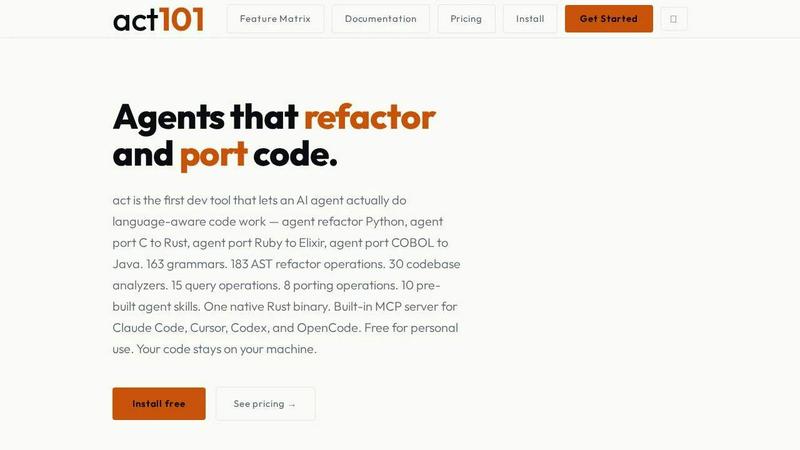
About act101
act101 is a revolutionary developer tool that finally lets AI agents perform real, language-aware code transformations like refactoring and porting across an incredible 163 programming languages. Think of it as a superpower for your AI coding assistant. Instead of just chatting about code or doing clumsy whole-file rewrites that break formatting and lose comments, act101 gives AI agents precise, typed operations that understand the abstract syntax tree (AST) of your code. This means your agent can safely extract a function, rename a symbol across an entire workspace, or even port a C library to Rust, all with automatic checkpointing and instant undo. The tool is built as a single, native Rust binary with a built-in Model Context Protocol (MCP) server, making it compatible with popular AI coding tools like Claude Code, Cursor, Codex, and OpenCode. It is designed for developers and teams who want to leverage AI for serious, production-grade code work without sacrificing control or security. Your code stays on your machine, there is no telemetry, and it is free for personal use. act101 is not just another code tool; it is the first of its kind, bridging the gap between AI conversation and actual, reliable code manipulation.
Features of act101
183 AST-Aware Refactor Operations
act101 provides an extensive library of 183 abstract syntax tree (AST) aware refactoring operations. These are not simple text replacements. Each operation, like extract-function, rename-symbol, move-symbol, convert-to-dataclass, or inline, works by understanding the structure and semantics of your code. This ensures that changes are consistent, safe, and maintain the original formatting and logic. The agent can call these operations across your entire codebase, and every operation is automatically checkpointed, allowing for instant undo if the result is not what you expected. This feature transforms AI from a code suggestion tool into a true code manipulation partner.
8 End-to-End Porting Operations
Porting code from one language to another is a complex, error-prone task. act101 simplifies this with 8 dedicated porting operations that drive a structured state machine. The process begins with port_contract to define the scope of the migration, followed by port_inventory to list every symbol that must move. Then, port_order resolves the dependency chain, and a port_manifest state machine (with states like init, add, update, remove, and note) tracks progress. This systematic approach works between any two of the 163 supported grammars, enabling agents to port C to Rust, Ruby to Elixir, or even COBOL to Java with a clear, auditable plan.
30 Codebase Analyzers for Deep Insight
Before any AI agent modifies your code, it needs to understand the existing structure. act101 provides 30 built-in codebase analyzers that give the agent a deep, structural map of your repository. These analyzers can detect coupling between modules, identify cyclic dependencies, find dead code, pinpoint architectural hotspots, analyze module boundaries, and assess migration readiness. By using these analyzers, your AI agent can make informed decisions, prioritize changes, and avoid introducing new problems. This turns the AI into a smart architect that can see the big picture before making any moves.
10 Pre-Built Agent Skills for Common Workflows
act101 comes with 10 pre-built agent skills that combine multiple operations into powerful, ready-to-use workflows. These skills are designed for common engineering tasks and can be invoked with a simple command like /skill-name in your AI coding tool. Examples include architecture-audit for a full structural review, code-review for automated pull request feedback, refactoring for targeted code improvements, migration-assessment to evaluate the effort of porting code, and boundary-analysis to check module dependencies. These skills save you from having to chain multiple operations manually, making complex tasks feel effortless.
Use Cases of act101
Refactoring a Large Python Monolith
Imagine you have a sprawling Python application with deeply nested functions and tight coupling between modules. With act101, you can ask your AI agent to refactor it. The agent uses the architecture-audit skill to get a map of the codebase, identifies chokepoints and high-coupling areas, and then systematically applies operations like extract-function to break down large methods, move-symbol to relocate classes to more appropriate modules, and rename-symbol to improve naming conventions. Each step is checkpointed, so you can instantly undo any change that doesn't fit, making the process safe and iterative.
Porting a C Library to Rust for Safety
You have a mature, performance-critical C library that you want to migrate to Rust for its memory safety guarantees. act101 makes this manageable. You define the scope with port_contract, and the agent uses port_inventory to list every function, struct, and global variable. It then uses port_order to figure out the dependency sequence and begins the migration using the port_manifest state machine. The agent translates C patterns into idiomatic Rust, handling ownership and borrowing. The result is a Rust library that is functionally equivalent but safer, with a clear migration log showing every step.
Automating Code Review on a Pull Request
When a team member submits a pull request, you can use act101 to perform an automated, deep code review. The agent invokes the code-review skill, which runs several analyzers on the changed code. It checks for code smells, potential dead code, increased coupling, and architectural boundary violations. The agent then provides a structured report with specific suggestions for improvement, like "Consider extracting this block into a separate function to reduce complexity" or "This new module introduces a circular dependency with module X." This elevates code reviews from a manual, time-consuming task to an automated, insightful process.
Assessing Migration Feasibility for a Legacy System
Your company has a legacy COBOL system that needs to be modernized, but you are unsure of the effort required. act101 can help with a migration-assessment. The agent scans the entire COBOL codebase using the 30 analyzers, focusing on migration readiness. It identifies the number of modules, their dependencies, and potential roadblocks like platform-specific code or complex data structures. It then provides a detailed report with an estimated effort breakdown and a recommended migration strategy, such as porting to Java or C#. This gives you the data you need to make a business case for the modernization project.
Frequently Asked Questions
How does act101 ensure my code is safe during refactoring?
act101 uses AST-aware operations that understand the structure of your code, not just the text. This means changes are precise and less likely to introduce errors. Additionally, every operation is automatically checkpointed. If the AI agent makes a change you don't like, you can instantly undo it and revert to the previous state. The tool is designed to be a collaborative partner, giving you full control and the ability to review every change.
Is act101 compatible with my existing AI coding tools?
Yes, act101 is built around the Model Context Protocol (MCP), which is an open standard. It works seamlessly with popular AI coding assistants like Claude Code, Cursor, Codex, and OpenCode. You simply set up the MCP server, and your AI agent can immediately start using the powerful refactoring, porting, and analysis operations. It is designed to be a drop-in upgrade for your current AI-powered development workflow.
Does act101 send my code to external servers?
No, your code stays on your machine. act101 is a single native Rust binary that runs locally. It performs all parsing, analysis, and transformations locally. The only time it might contact an external server is for license verification, which does not involve sending your code. There is no telemetry or data collection, ensuring your intellectual property remains private and secure.
How many programming languages does act101 support?
act101 supports an impressive 163 programming languages. This includes all major languages like Python, JavaScript, TypeScript, Rust, Go, Java, C, C++, C#, Ruby, and Elixir, as well as many legacy and niche languages like COBOL, Fortran, and Haskell. This broad support makes it a valuable tool for teams working with diverse technology stacks or managing migrations between very different languages.
Pricing of act101
act101 is free for personal use. This allows individual developers to use all the features, including the 183 refactor operations, 30 analyzers, and 8 porting operations, without any cost. For commercial or team usage, there is a paid pricing tier. You can find the specific details for commercial plans and pricing on the act101 website under the "Pricing" section. The free personal tier is a great way to experience the power of AI-driven code work and see how it can transform your development process.
Similar to act101

shardstitch
ShardStitch helps recover and hand off AI coding work, with a visual website editor and SEO Guardrails MCP in development.

GetYouTubeTranscript
YouTube transcripts, search and channel data via one API

stackledge
The human-curated directory of verified AI tools, active SaaS, and custom n8n workflows. Discover dependable software free from bot-scraped spam.


laya.tools
Free directory of 950+ projects built on Laya, the open-source model that turns text into typed decisions in milliseconds.

Sprite Sheet Maker
A free browser-based toolkit for creating, cutting, converting, and previewing sprite sheet animations.

Kody Tools
Hub of 600+ free online tools such as converters, calculators, image tools, etc

Binary Code Translator
Convert text to binary and back — instantly, privately and for free, right in your browser.