

Frizzle
Frizzle snaps photos of handwritten math work and instantly gives teachers live analytics on every student's thinking and misconceptions.
About Frizzle
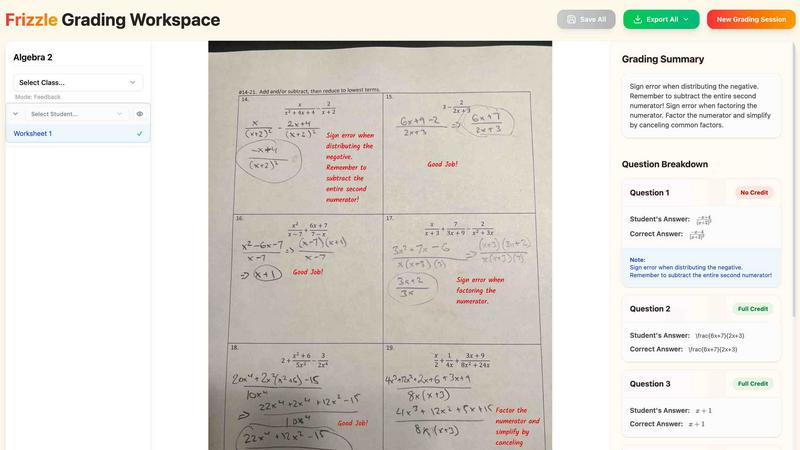
Frizzle is an AI-powered platform designed to be the operating system for math classrooms. It uses a combination of computer vision and large language models (LLMs) to read and grade handwritten student work with 97% accuracy. The core idea is simple: students keep writing on paper using their normal workflow, and teachers simply photograph a stack of papers or run them through a copier. Within minutes, Frizzle reads every page, recognizes individual student handwriting, and understands each step of their problem-solving process, not just the final answer.
The product is built for K-12 math teachers, instructional coaches, and school or district administrators. For teachers, the main value proposition is reclaiming the 10 to 15 hours per week they typically spend grading by hand. Instead of spending Sunday evening with a red pen, teachers can snap a photo and get instant, detailed feedback on every student's work. Frizzle identifies specific misconceptions, tags them to Common Core State Standards (CCSS) and other state frameworks, and provides live dashboards showing which concepts each class and student has mastered. This shifts the focus from simple right-or-wrong grading to deep, actionable insight into student thinking.
For schools and districts, Frizzle acts as a live nervous system for math instruction. It aggregates anonymized data across all classrooms, providing coaches and administrators with a clear map of where to invest resources, what concepts need reteaching, and which curricula are actually working. The platform is currently live in over 30 schools and districts, including a college math pilot at Vanderbilt University and Arizona State University. It is FERPA and COPPA compliant, ensuring student data remains private and secure. With over 142,000 problems read and 2,400 teachers using the platform, Frizzle is transforming how math classrooms operate by turning paper-based work into granular, actionable data.
Features of Frizzle
Handwriting Recognition and Step-Level Grading
Frizzle is not just a simple answer checker. Its computer vision model is trained on 1.4 million pages of real K-12 student work, allowing it to read any type of handwriting, including print, cursive, scribbled notes, and sideways text. More importantly, it analyzes every step of a student's solution, not just the final answer. This means it can understand multiple solution paths, award partial credit for correct reasoning even if the final answer is wrong, and pinpoint exactly where a student's thinking went off track. For example, if a student makes a sign error in the middle of solving an equation, Frizzle flags that specific step rather than simply marking the whole problem wrong.
Misconception Identification and Standards Alignment
The platform goes beyond grading to identify and name specific misconceptions. Frizzle has a library of 147 named misconceptions across K-12 math, all mapped directly to standards like CCSS, TEKS, and over 30 other state frameworks. When a student makes a common error, such as misapplying the distributive property, Frizzle tags that misconception and links it back to the exact stroke on the page. This feature also includes prerequisite tracing, which means the system can recognize when a 7th-grade error is actually caused by a gap in 4th-grade foundational knowledge. This gives teachers a precise roadmap for intervention.
Live Classroom and District Dashboards
Frizzle provides real-time dashboards that update live as papers are read. For a teacher, this means seeing a full class overview within about eight minutes of snapping a stack of papers. The dashboard shows which students are stuck, which misconceptions are spreading through the room, and what specific concepts need to be taught the next day. For schools and districts, Frizzle aggregates this signal across periods, grades, and buildings. Coaches and administrators can view equity dashboards to spot performance gaps the moment they emerge and see which curricula are producing the best results, all without waiting for end-of-year assessments.
Confidence-Interval System with Human Review Flags
To ensure accuracy and reliability, Frizzle uses a confidence-interval system that flags uncertain grades for human review. When the AI is not 100% confident in its assessment of a student's work, it marks that paper for the teacher to check. This system maintains a 97% accuracy rate while ensuring that no student is penalized by a potential AI error. Teachers can quickly review flagged papers, confirm or correct the grade, and move on. This hybrid approach combines the speed of AI with the essential judgment of a human educator, making the system trustworthy for high-stakes classroom use.
Use Cases of Frizzle
Daily Homework and Classwork Grading
A math teacher with five classes of 30 students each can spend over 15 hours a week grading homework and classwork by hand. With Frizzle, the teacher simply collects the papers, snaps a photo of each stack using a phone or document camera, and uploads them. Within minutes, Frizzle reads every paper, assigns grades, and identifies common errors. The teacher can then use the live dashboard to see which problems were most challenging for the entire class. This turns grading time into planning time, allowing the teacher to prepare targeted lessons that address the specific gaps revealed by the data.
Identifying and Addressing Spreading Misconceptions
During a unit on solving linear equations, a teacher notices that many students are making the same error: forgetting to distribute the negative sign. Frizzle's dashboard flags this as a "sign error" misconception and shows that it is spreading across the classroom. The teacher can immediately pause the lesson, pull up the specific examples from student papers, and do a quick whole-class reteach on that single concept. Instead of waiting for a test to discover the problem, the teacher addresses it in real time, preventing the misconception from becoming ingrained.
Standards-Level Coaching and Professional Development
An instructional coach is working with a math department to improve student performance on algebraic thinking standards. Instead of relying on generic observations or end-of-year test scores, the coach uses Frizzle's district dashboard to see which specific CCSS standards are causing trouble across all algebra classes. The data shows that students are struggling with standard 8.EE.C.7, which involves solving linear equations with rational coefficients. The coach can then lead a targeted professional development session focused on teaching strategies for that specific standard, using real student work examples from the building.
Reducing Screen Time While Maintaining Data Quality
A school district has a goal to reduce the amount of time students spend on screens during the school day. Many digital math programs require students to work on tablets or computers, which conflicts with this goal. Frizzle solves this problem by allowing students to continue writing on paper, which research shows can improve learning and retention. The district still gets the granular, classroom-level data it needs for accountability and intervention, but without forcing students to stare at screens. This approach keeps the focus on the math and the thinking, not the technology.
Frequently Asked Questions
How does Frizzle handle different types of handwriting?
Frizzle's AI model was trained on 1.4 million pages of real student work, which includes a wide variety of handwriting styles, from neat print to messy cursive and even sideways scribbles. The system is designed to recognize individual student handwriting over time, becoming more accurate as it sees more work from the same student. It can handle different languages, numbers that are written in multiple ways, and unconventional problem layouts. If the AI is ever unsure about a specific character or step, it flags that paper for human review rather than making a potentially wrong assumption.
Is Frizzle compatible with my curriculum or textbook?
Yes, Frizzle is curriculum-agnostic, meaning it works with any math curriculum or textbook. Whether you use Eureka Math, Illustrative Mathematics, Saxon Math, or a district-created curriculum, Frizzle can read the problems and student work. The system is trained on general mathematical notation and problem-solving patterns, not specific textbook layouts. It aligns its grading and misconception tagging to standards like CCSS and TEKS, so the data is always relevant to your learning objectives. You simply assign the problems as you normally would, and Frizzle handles the rest.
What about student data privacy and security?
Student privacy is a foundational part of Frizzle's design, not an afterthought. The platform is fully FERPA and COPPA compliant, and it undergoes SOC 2 Type II audits annually to verify its security practices. Student work is never used to train the AI model, meaning your students' data remains yours and is not used to improve the system for other users. All data is encrypted using AES-256 at rest and TLS in transit. Frizzle also allows schools and districts to set their own data retention policies and delete data at any time.
How long does it take to grade a class of papers?
The process is very fast. Step one is snapping the stack of papers, which takes about 30 seconds for a typical class of 30 students. You can use a phone camera, a document camera, or a scanner. Step two is Frizzle reading everything. The AI processes the images and analyzes the student work, which takes approximately eight minutes per class. Step three is seeing the results, which update live on the dashboard. So from the time you take the photo to the time you have full class analytics, it is usually under ten minutes. This is a dramatic improvement over the hours it would take to grade by hand.
Similar to Frizzle

Teacher Planner
Online lesson planner and AI tools to help teachers organize schedules and prepare classroom materials.

imgtxtapp.laviolab.com
imgtxtapp.laviolab.com is a Telegram-based image-to-text converter that turns photos, screenshots, scanned documents into editable text

LittleStory
AI bedtime stories for kids 2-10: personalized illustrated stories starring your child, narrated in your cloned voice. Free to start, ad-free.

Vizle
Vizle transforms lengthy videos into convenient, accessible documents, as PDFs and PPTs. No more speeding through your videos at 2x!

Verla AI
AI academic assistant for writing, research, presentations, and coding

Parlune
Learn a language from real content, not vocab dumps. Parlune turns your favourite foreign-language YouTube videos into immersive, audio-synced lessons


WriteSprout
Free handwriting worksheet generator for name tracing, cursive and alphabet practice. Customize, preview, print or download as PDF.