

Game Server Backend
Game Server Backend unifies player auth, data, leaderboards, and server hosting into one simple API for multiplayer games.
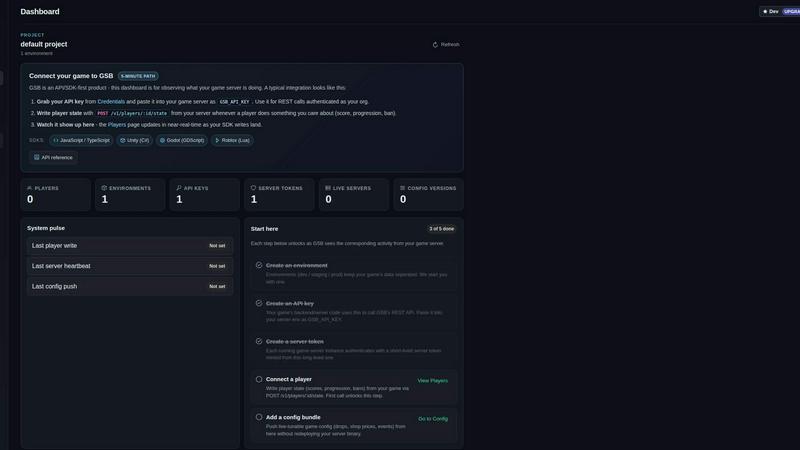
About Game Server Backend
Game Server Backend (GSB) is a hosted backend platform purpose-built for studios and indie developers creating multiplayer games. It bundles all the operational infrastructure a multiplayer title needs behind a single, unified API, so teams can ship their game without the pain of rebuilding backend services from scratch. GSB covers matchmaking, leaderboards with both global and regional scopes, player profiles, persistent JSON state per user, a server registry for community-server discovery, in-game economy primitives, and a live-ops configuration layer that lets you push gameplay tuning updates without requiring a client patch. Three authentication paths are supported out of the box: anonymous accounts that can upgrade later, passwordless email sign-in, and Steam OpenID for PC titles. Drop-in SDKs ship for Unity, Unreal Engine, and Godot, each wrapping the underlying REST layer in idiomatic, type-safe APIs so existing engine patterns work without ceremony. The platform also integrates seamlessly with Roblox and custom game servers, making it a versatile choice for any multiplayer project. GSB is designed to eliminate the need to stitch together separate vendors for auth, persistence, rankings, config rollout, and server discovery, providing a cleaner path from prototype to live production. With a free forever Dev plan and no credit card required, it is accessible to teams of all sizes.
Features of Game Server Backend
Player Authentication
GSB supports multiple authentication paths to suit different game types and player preferences. You get email and password sign-in, guest sessions for quick onboarding, OAuth integrations with Google, GitHub, and Discord, plus Roblox verification for titles on that platform. Anonymous accounts can be created instantly and upgraded later to full accounts, reducing friction during the first play session. For PC titles, Steam OpenID is supported out of the box. All authentication is handled server-side, keeping player credentials secure and freeing you from building and maintaining your own auth system.
Persistent Player Data
Store player-scoped and project-scoped JSON documents for progression, profiles, unlocks, event flags, inventories, and shared runtime values. GSB provides server-authoritative storage with patch semantics, meaning you can update specific fields without rewriting entire documents. This makes it ideal for tracking complex player state across sessions, from experience points and level data to quest progress and cosmetic unlocks. The system handles concurrent writes safely, ensuring data integrity even during high-traffic events like launch days or seasonal content drops.
Leaderboards and Rankings
Create ranked and seasonal leaderboards with configurable rules, fast ranking reads, and recurring resets. GSB supports both global and regional scopes, so you can show world rankings alongside localized leaderboards for better player engagement. Anti-cheat friction is built into the write path, helping prevent score manipulation. You can also run timed events or score-based loops, with leaderboards that automatically reset on a schedule you define. This feature is essential for competitive games, seasonal events, and any title that wants to foster ongoing player competition.
Live Config Delivery
Upload versioned configuration bundles and activate them per environment, so balance changes, rotations, loot tables, and rulesets can ship without a full client patch. This live-ops layer lets you respond to player feedback, fix balance issues, or introduce new content on the fly. You can maintain separate configurations for staging and production, test changes safely, then promote them with confidence. This feature is a game-changer for live-service titles that need to evolve rapidly without forcing players to download updates.
Use Cases of Game Server Backend
Indie Multiplayer Game Launch
An indie studio building a competitive multiplayer shooter can use GSB to handle player authentication, matchmaking, leaderboards, and persistent player stats out of the box. Instead of spending months building backend infrastructure, the team can integrate the Unity SDK in a few hours and focus on core gameplay. The free Dev plan lets them prototype and iterate without financial risk, and when they are ready to launch, the same platform scales with them to production.
Seasonal Event Management
A live-ops team running a battle royale title can use GSB's live config delivery to push new loot tables, balance changes, and event rulesets without patching clients. Combined with seasonal leaderboards that reset automatically, they can run themed events every few weeks, keeping the player base engaged. Persistent player data tracks event-specific progress and rewards, while the economy system handles currency grants and item unlocks atomically.
Community Server Browsing
A sandbox or survival game that relies on community-run dedicated servers can use GSB's server registry to power an in-game server browser. Servers register themselves with heartbeats, players can discover region-aware listings, and stale servers are cleaned up automatically. Matchmaking tickets can route players to specific server pools, and admin tooling allows for forced forms and queue management. This creates a seamless experience for players looking to join friends or find active sessions.
Cross-Platform Progression
A game shipping on Unity, Roblox, and custom game servers can use GSB to unify player data across all platforms. A player who unlocks a cosmetic item on Roblox can see it available when they log in via the Unity client. Persistent JSON state and the economy system ensure that currencies, inventories, and progression are consistent regardless of the platform. The three supported authentication modes (API Key, Server Token, Player JWT) make it easy to secure these cross-platform interactions.
Frequently Asked Questions
Is Game Server Backend free to use?
Yes, GSB offers a free forever Dev plan that requires no credit card to sign up. This plan is designed for prototyping, development, and small-scale testing. When you are ready to move to production, paid plans are available that scale with your player base and feature needs. You can start building today with zero financial commitment.
Which game engines does GSB support?
GSB provides drop-in SDKs for Unity, Unreal Engine, and Godot. Each SDK wraps the underlying REST API in idiomatic, type-safe code that fits naturally with the engine's patterns. Additionally, GSB works with Roblox and any custom game server that can make HTTP requests, since the core API is REST-based and well-documented.
How does GSB handle player authentication?
GSB supports three primary authentication paths. Anonymous accounts let players start playing immediately and upgrade later to full accounts. Passwordless email sign-in sends a magic link for quick, secure access. For PC titles, Steam OpenID is supported. Additionally, OAuth integrations with Google, GitHub, and Discord are available, along with Roblox verification for titles on that platform.
Can I use GSB for both development and production environments?
Absolutely. GSB is environment-aware by design, supporting separate workspaces for staging and production. You can test config changes, leaderboard resets, and economy updates in a staging environment before promoting them to production. This clean separation helps teams move from prototype to live without the backend becoming a bottleneck.
Similar to Game Server Backend

IdeaAize Free AI Tools
IdeaAize Free AI Tools is a suite of 50+ free online utilities that run 100% in your browser — no registration, no file uploads, no watermarks.

TokenSave
Free AI token counter and cost calculator for ChatGPT, Claude and Gemini, plus a private Claude Code usage analyzer.

APIKO AI API
One OpenAI-compatible endpoint for text, image and video models from OpenAI, Anthropic, Google, DeepSeek and more.

BlazePhoenix
On-chain DEX aggregator: the swap route is computed inside the transaction that executes it. No API key, no signup.

SiteScoper
AI Website UX Auditor & Instant SEO Checker

AFFLIGO
AFFLIGO is a free online toolkit for everyday file tasks. Easily edit PDFs, compress images, convert file formats, and get things done.

SightRadar
Face recognition API, a drop-in replacement for AWS Rekognition. Index, search, compare and detect faces, billed per photo with no subscription.
