

Tuning Engines
Tuning Engines simplifies AI integration by offering a single API for model access, tuning, and governance with zero markup costs.
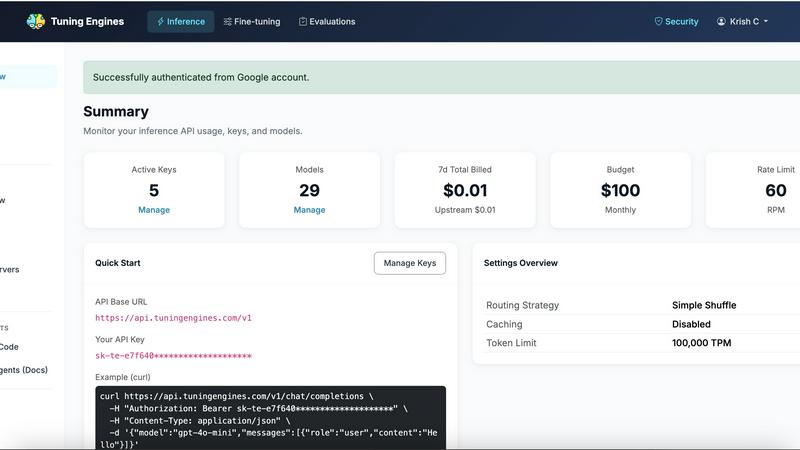
About Tuning Engines
Tuning Engines is a comprehensive AI control and governance platform designed for teams that are focused on developing production intelligence across various models, agents, tools, and fine-tuned systems. This innovative solution streamlines the entire AI lifecycle, allowing organizations to manage inference, model routing, fallback policies, fine-tuning jobs, datasets, evaluations, and much more from a single, governed interface. Tuning Engines is particularly valuable for developers and administrators who require robust controls and seamless integrations. By providing OpenAI-compatible APIs, role-based access, and a centralized policy framework, Tuning Engines enables organizations to transition from isolated AI experiments to a secure, observable, and extensible AI operating layer. This ensures that models can be efficiently trained, evaluated, routed, governed, and utilized by agents and tools at scale, ultimately enhancing productivity and reducing operational costs.
Features of Tuning Engines
Unified Inference
Tuning Engines offers a single OpenAI-compatible endpoint that allows users to access open, commercial, and custom-tuned models. This unified approach simplifies model deployment and eliminates the need for multiple integrations, enabling teams to focus on their core objectives without worrying about infrastructure complexities.
Model Tuning
With Tuning Engines, users can easily adapt models to align with their specific data, workflows, and production goals. This feature supports supervised fine-tuning, LoRA adapters, and evaluation gates, ensuring that the quality of AI outputs evolves alongside business needs, thus maximizing impact.
Role-Based Access and Governance
Admins have access to essential controls that ensure secure AI operations. Tuning Engines implements role-based access, per-key budgets, rate limits, and fallback rules. These governance features provide teams with the ability to manage resources effectively while maintaining compliance with organizational policies.
Centralized Analytics and Auditability
The platform provides centralized analytics, allowing teams to capture data, analyze usage traces, and maintain auditability across all AI interactions. This feature not only enhances transparency but also supports informed decision-making by offering insights into performance and resource utilization.
Use Cases of Tuning Engines
Code Assistance
Developers can leverage Tuning Engines to enhance their coding workflows through IDE copilots, code generation, refactoring, and debugging agents. By integrating these capabilities into their development environments, teams can accelerate their coding processes and improve overall code quality.
Conversational AI
Organizations can build sophisticated customer support bots and internal helpdesks using Tuning Engines. This use case encompasses multilingual chat capabilities, enabling businesses to provide efficient and accessible support to a diverse customer base.
Search & Retrieval
Tuning Engines excels in semantic search and enterprise assistant deployments. By utilizing its advanced models, organizations can create tailored search experiences, offering personalized recommendations and improving information retrieval from knowledge bases and private documents.
Multimodal Applications
The platform supports the development of multimodal applications that integrate text, vision, and speech models in real-time workflows. This versatility allows organizations to create innovative solutions that cater to various user interaction preferences and enhance user experience.
Frequently Asked Questions
What is Tuning Engines?
Tuning Engines is an AI control and governance platform that enables organizations to manage the full AI lifecycle, from model training to deployment, in a single, unified system. It offers features for inference, model routing, and analytics, catering to both developers and administrators.
How does model tuning work in Tuning Engines?
Model tuning in Tuning Engines allows users to adapt existing models to their specific data and production goals. It supports various techniques, such as supervised fine-tuning and LoRA adapters, enabling organizations to improve model performance based on their unique requirements.
Can Tuning Engines integrate with existing workflows?
Yes, Tuning Engines is designed for seamless integration with existing workflows. Developers can use OpenAI-compatible APIs to connect their applications without the need for extensive code modifications, allowing for a smooth transition to this powerful AI platform.
What governance features does Tuning Engines offer?
Tuning Engines provides a range of governance features, including role-based access, per-key budgets, rate limits, and centralized policy controls. These features ensure that AI operations are secure, compliant, and manageable, enabling organizations to maintain oversight over their AI resources.
Similar to Tuning Engines

Fireply AI
AI reply agent for X: finds relevant conversations and replies in your own voice. 40 replies free, no card.

Backlane
Connect Claude, ChatGPT and other AI assistants to your marketplace accounts to analyse listings, orders, inventory and advertising.

DataLens
AI web scraper for Chrome and Edge. Open a product list, search results or a comment thread, click once, and export clean rows to CSV, Excel or JSON.

DeskBot
DeskBot for Kalshi event contracts. $1 first month, then $19.99/mo. Trading can lose money. Not affiliated with Kalshi.

ChatFrom
Build an AI chatbot from your own documents and website, connect it to your own tools, and put it on your site with one script tag. Free to start.

Promptifi
Reviewed AI prompts and workflows for B2B sales, from account research to renewal. Run them in ChatGPT, Claude, Gemini or Copilot. 100 free.

OpenDaemon
Free Windows AI agent app: describe an app in plain words and it plans and builds it phase by phase with your coding app.
