

Crystal Identifier
Crystal Identifier uses AI to instantly name any crystal, rock, or gem from a photo and gives you its hardness, properties, and value.
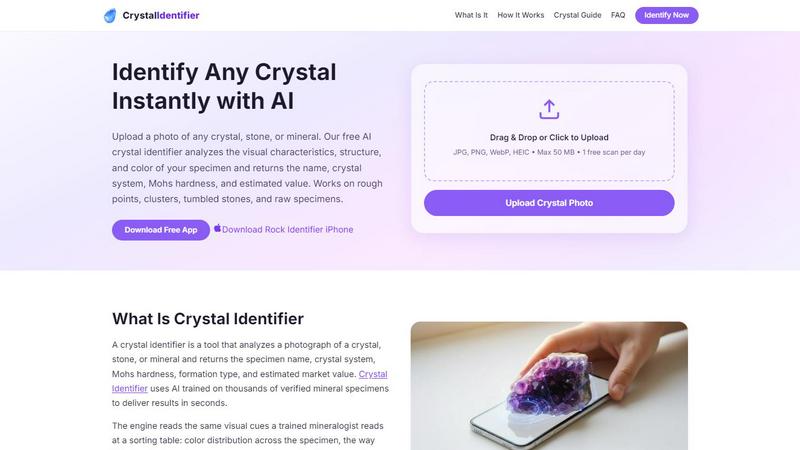
About Crystal Identifier
Crystal Identifier is a freemium AI-powered tool designed to help you identify crystals, gemstones, minerals, rocks, fossils, and stones simply by uploading a photo. Whether you are a collector sorting through a recent haul, a student preparing for a geology exam, a teacher looking for engaging classroom examples, or a lapidary hobbyist trying to label a new find, this tool makes identification fast and accessible. The core value proposition is simplicity: snap a picture, and within seconds, the AI returns the likely name of your specimen along with critical reference details like its crystal system, Mohs hardness, formation type, and even an estimated market value range. The AI engine has been trained on thousands of verified mineral specimens, allowing it to read visual cues such as color distribution, light refraction, crystal face angles, and surface texture. It handles a wide variety of specimen types, including rough points, clusters, tumbled stones, polished cabochons, and raw specimens. Importantly, Crystal Identifier offers a free tier, making it an excellent starting point for anyone curious about a mysterious stone. While the AI provides a strong first estimate, it is always a good idea to verify results with physical tests and expert references when accuracy is critical. The platform is available on web, iOS, and Android, so you can use it at home, in the field, or in a shop. Additionally, the site includes a blog with identification guides and comparison articles to help users distinguish similar-looking stones and learn key terminology.
Features of Crystal Identifier
Instant AI Photo Identification
Upload a photo of any crystal, stone, or mineral, and the AI engine analyzes visual characteristics like color saturation, transparency zones, crystal habit geometry, luster type, and surface texture. It compares these features against a verified reference dataset of thousands of mineral species to return the specimen name, crystal system, Mohs hardness, formation environment, and estimated value. Results typically appear in about four seconds.
Multi-Platform Accessibility
Crystal Identifier is available as a web app and as native applications for iOS and Android devices. This means you can identify specimens at home on your computer, out in the field using your smartphone, or even in a shop while considering a purchase. The apps support common image formats like JPG, PNG, WebP, and HEIC, with a maximum file size of 50 MB.
Comprehensive Result Details
Beyond just naming the stone, the tool provides a wealth of reference information. For each identified specimen, you receive the mineral name, its crystal system, the Mohs hardness rating, the typical formation environment, and an estimated value range. If the AI has lower confidence in its identification, it lists alternative candidates ranked by probability, helping you narrow down your options.
Educational Blog and Guides
The platform includes a dedicated blog section with identification guides and comparison articles. These resources help users distinguish between similar-looking stones, such as amethyst versus fluorite, and learn important terminology related to crystal systems, luster types, and formation processes. This feature is especially valuable for students, teachers, and hobbyists looking to deepen their knowledge.
Use Cases of Crystal Identifier
Sorting and Labeling a Personal Collection
If you have accumulated a mixed bag of crystals, tumbled stones, or mineral specimens from various sources, Crystal Identifier helps you quickly sort and label each piece. Upload a photo of each specimen, and the AI provides a likely name along with supporting details like hardness and value. This makes it easy to organize your collection, create display labels, or update your inventory records without needing specialized equipment.
Preparing Classroom Examples for Geology Lessons
Teachers can use Crystal Identifier to quickly verify and label specimens before bringing them into the classroom. Uploading a photo of a rock, mineral, or fossil provides immediate information about its identity and properties, which can be used to create engaging lesson materials. The tool also helps teachers answer student questions about unknown samples brought in from home, making geology lessons more interactive and hands-on.
Verifying Marketplace Listings Before Purchase
When shopping for crystals or minerals online, it can be difficult to confirm that a listing is accurate. Crystal Identifier allows you to upload a photo from a marketplace listing to get a second opinion on the specimen's identity and estimated value. This helps you avoid overpaying for a misidentified stone or purchasing a common mineral labeled as a rarer one, giving you more confidence in your buying decisions.
Narrowing Down Candidates Before Physical Testing
For serious hobbyists or lapidary enthusiasts, Crystal Identifier serves as an excellent preliminary screening tool. Before performing more involved physical tests like specific gravity or refractive index measurements, you can upload a photo to get a shortlist of likely candidates. This saves time and effort by focusing your testing on the most probable minerals, especially when dealing with similar-looking specimens like different varieties of quartz or feldspar.
Frequently Asked Questions
What app identifies a crystal from a photo?
Crystal Identifier is the app you are looking for. It is available as a web app and as native applications for iOS and Android devices. Simply upload a photo of your crystal, stone, or mineral, and the AI will analyze its visual characteristics to return the likely name along with details like Mohs hardness, crystal system, and estimated value.
Is there a free tool to identify gemstones and minerals with AI?
Yes, Crystal Identifier offers a free tier that allows you to perform one free scan per day. This makes it an excellent starting point for anyone curious about a mysterious stone. The free version provides the same core identification features as the paid version, including the specimen name, hardness, and estimated value range.
How accurate is the AI crystal identification?
The AI is trained on thousands of verified mineral specimens and provides a strong first estimate based on visual cues like color, transparency, crystal habit, and luster. However, results depend on photo quality, lighting, and visible features. The AI cannot measure hardness, specific gravity, or refractive index from a photograph. For critical applications, results should be verified with physical tests and expert references.
What types of specimens can Crystal Identifier identify?
Crystal Identifier supports a wide range of specimen types, including rough crystals, polished cabochons, clusters, geodes, tumbled stones, rocks, fossils, and minerals. The AI works best when the photo is taken in natural light with a plain background, and when crystal faces are visible. For dull surfaces, misting with water can help reveal color and grain detail.
Explore more in this category:
Similar to Crystal Identifier

TestNeo
TestNeo.ai is an AI-native engineering and release assurance platform that helps teams automate web and API testing using natural language.

VoiceVibe
Talk to your computer: dictate, rewrite, ask about your screen, launch AI agents.

Booksmaker.ai
Books Maker AI is the AI-powered platform that turns your idea into a professional book.

Toolara Music
Describe a song in plain text and get a complete track — vocals or instrumental, custom lyrics, up to 120 seconds, MP3 download

LinkIntel
MCP server giving your AI assistant your X post results and X’s ranking weights, with sources.

Ask Versa AI
AI verdicts for any two Amazon products, in seconds. Live specs plus real buyer reviews, scored 0-100, one clear winner. Free, no account.

Verla AI
AI academic assistant for writing, research, presentations, and coding

TryThatTool
Discover AI tools worth trying. Compare options, explore practical reviews, and build your own AI stack based on your goals and budget.